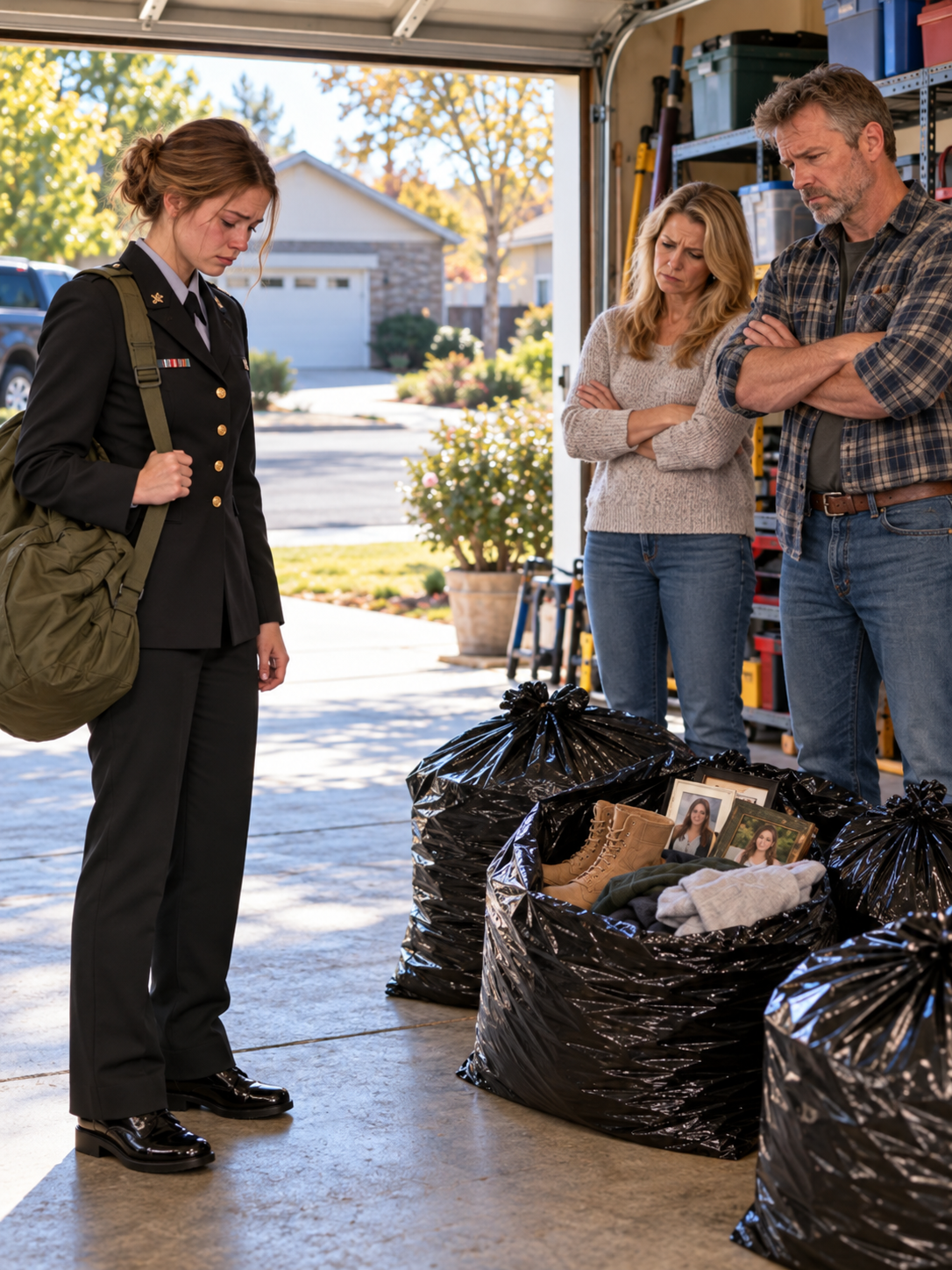
Chapter 1: After returning home from a nine-month deployment, I found nearly everything I owned stuffed into black trash bags inside my own house.
After returning home from a nine-month deployment, I discovered almost everything I owned stuffed into black trash bags inside my own house. Rather than confronting anyone immediately, I quietly checked the original deed my grandfather had placed in a trust for me, just to make completely certain. By the next morning, my parents and my sister…
I opened the first black bag.
My combat boots were inside.
The second bag contained my clothes.
Jeans.
Hoodies.
Old PT shirts.
Someone had packed away almost everything I owned while I’d been deployed overseas.
Then I heard my mother’s voice behind me.
“You came home earlier than we expected.”
I turned around.
Evelyn stood in the doorway, perfectly calm.
My father, Richard, was standing just behind her.
“I told you when I was coming home.”
Mom gave a slight shrug.
“Well, plans changed.”
Dad took a step closer.
“We had to make a few adjustments while you were gone.”
I looked around the house.
The furniture had been rearranged.
Different photographs now hung on the walls.
Decorations I’d never seen before filled the shelves.
With every second that passed, the place felt less and less like my home.
“Where’s Chloe?”
“Upstairs resting.”
“And Vance?”
Mom hesitated.
That was when it finally clicked.
My sister and her husband had moved into my house.
I glanced toward the staircase.
“What happened to my bedroom?”
Mom actually smiled.
“Chloe needed the master bedroom.”
I stared at her.
“So where exactly am I supposed to sleep?”
Dad answered as though the matter had already been decided.
The unfinished basement.
Or, if that didn’t work for me, I could return to the barracks.
“You’re single,” Mom added. “And you’re gone most of the time anyway. You don’t need an entire house.”
Then she repeated the same sentence I’d heard in one form or another for most of my life.
“Be a good sister for once.”
They were expecting me to lose my temper.
Dad’s shoulders were already tense.
Mom wore that familiar expression she always had when she was preparing for an argument.
But I gave them nothing.
I crouched down.
Closed the trash bag.
Carefully tied it shut.
Then carried it downstairs.
Behind several old storage boxes was a loose section of flooring that almost nobody knew existed.
I lifted it.
The small hidden safe underneath was still there.
Untouched.
They hadn’t found it.
I entered the combination.
Inside was a waterproof folder my grandfather had warned me never to lose.
I opened it.
And there it was.
The original deed.
I read the ownership section twice.
My father’s name wasn’t listed.
Neither was my mother’s.
Chloe’s definitely wasn’t.
Mine was.
Years earlier, Grandpa had transferred the property to me through a trust.
My family knew he’d made certain arrangements involving the house, but they’d never taken the time to understand exactly what those arrangements meant.
Apparently, they’d simply assumed they could take control of the property while I was deployed.
From upstairs, I heard laughter.
Someone opened the refrigerator.
A cabinet door slammed.
They were moving through my house as if it belonged to them.
I looked down at the deed.
Then I smiled.
They had no idea what they’d just done.
I should have stopped there.
Instead, I opened my laptop.
And that was when everything became much worse.
I checked my financial accounts.
My hazardous-duty pay wasn’t where it was supposed to be.
Several deployment bonuses were missing too.
I began scrolling backward.
Transfer.
Transfer.
Withdrawal.
Another transfer.
Every one of them had been made while I was overseas.
My stomach tightened.
Then I discovered an authorization document attached to the account.
A power of attorney.
It named my mother as my authorized agent.
I opened the document.
My name appeared at the bottom.
And beneath it was a signature that was supposed to be mine.
Except I’d never signed it.
I stared at the screen.
Then I started totaling the transactions.
By the time I finished, nearly $45,000 was gone.
My family hadn’t simply taken over my house.
Someone had also been accessing my money while I was deployed.
Still, I said nothing.
I saved copies of everything.
Bank statements.
Transfer records.
The power of attorney.
Dates.
Account numbers.
Then I shut the laptop.
That evening, my parents hosted a barbecue.
In my backyard.
Chloe and Vance invited people over.
Dad stood beside my grill drinking beer while Mom carried food outside from my kitchen.
Not one person asked whether I was okay with any of it.
At one point, Dad motioned for me to follow him away from the others.
“You need to take care of something tomorrow.”
I looked at him.
“What?”
“Some paperwork. A transfer.”
“What exactly are we transferring?”
He gave me an irritated look.
“The house.”
For a moment, I honestly wondered whether he understood how absurd he sounded.
He explained that Chloe and Vance needed stability.
They were thinking about having children.
They needed more space.
And because my military career kept me away so often, there was supposedly no practical reason for me to continue owning the property.
“You want me to give Chloe my house?”
“It’s family property.”
“No. It isn’t.”
His jaw tightened.
“Don’t start.”
He told me the simplest solution was for me to voluntarily sign the house over.
“And if I refuse?”
Dad’s expression changed.
His voice dropped.
“I still have connections.”
I stayed quiet.
Then he reminded me that I was under consideration for promotion to major.
“It would be unfortunate,” he said, “if some unnecessary family issue complicated that.”
There it was.
Not advice.
Not a request.
Pressure.
He genuinely believed bringing up my career would frighten me into signing away my own house.
I glanced toward the backyard.
Chloe was laughing near the patio.
Vance had his feet propped on my outdoor furniture.
Mom was chatting with one of the neighbors as if she’d lived there for years.
Then I turned back to Dad.
And smiled.
“I’ll make sure the paperwork is handled exactly the way it needs to be.”
His shoulders relaxed.
“Good.”
He thought he’d won.
The following morning, I walked into the JAG office carrying a folder.
Captain Morales listened to everything without interrupting.
Then she began examining the documents.
The deed.
My bank records.
The transfers.
The account access.
Finally, she reached the power of attorney.
She studied the signature.
Then looked up at me.
“That isn’t your signature.”
“No, ma’am.”
She returned her attention to the banking records.
“Approximately forty-five thousand dollars was transferred while you were deployed?”
“Yes, ma’am.”
“And none of those transactions were authorized by you?”
“None.”
She slowly leaned back.
“This is already serious.”
Then she made a phone call.
Less than an hour later, a civilian real-estate attorney named Dalton joined us.
He specialized in property and trust disputes.
Dalton moved through the paperwork quickly.
The original deed.
Trust documents.
Tax records.
Bank documents.
Page after page.
At first, he barely said anything.
Then suddenly, his hand stopped.
He frowned.
“Wait.”
He flipped back toward the rear of the folder.
Then he pulled out a document I didn’t recognize.
He read the first page.
Then the second.
His expression shifted.
Captain Morales noticed immediately.
“What is it?”
Dalton didn’t answer right away.
Instead, he turned the document around and slid it across the desk toward me.
There was my name.
My property’s address.
And another signature I had never seen before in my life.
Dalton tapped the bottom of the page.
“Is this yours?”
I stared at it.
Then slowly shook my head.
“No.”
He looked over at Captain Morales.
And suddenly, the missing $45,000 was no longer the most serious problem.
After returning home from a nine-month deployment, I found nearly everything I owned stuffed into black trash bags inside my own house.
Chapter 2: THE NAME BENEATH MY SIGNATURE
Dalton kept staring at the document, but rather than explaining what it meant, he quietly covered the lower half of the page with his hand.
Captain Morales leaned closer, and the glance they exchanged made my stomach tighten.
“Do you recognize this date?” Dalton asked.
I looked at the place he was pointing to.
The document had been filed while I was still overseas—during a week when I hadn’t spoken to anyone in my family.
Then I noticed another line beneath my forged signature, partly concealed under Dalton’s hand.
I reached toward the page.
He stopped me.
“Before you read that name, there’s something else you need to see.”
Then he pulled another document from the folder.
He placed the second document beside the first.
At the top was the name of a lending company I only vaguely recognized. Beneath it was my address, followed by a string of numbers and legal descriptions that meant almost nothing to me.
Dalton ran his finger down the page.
“This is an application for a home-equity line secured by the property.”
I stared at him.
“I never applied for one.”
“I know.”
He turned another page.
The application claimed that I had personally authorized the property to be used as collateral.
It also claimed that I had provided identification, financial information, and written approval.
None of that was true.
I’d been thousands of miles away.
Captain Morales leaned forward.
“How much?”
Dalton pointed to the approved limit.
My chest tightened.
One hundred and twenty thousand dollars.
For several seconds, I simply stared at the number.
The missing $45,000 suddenly seemed like only one part of a much larger problem.
“Has all of that been withdrawn?” I asked.
“Not according to what I’m seeing here,” Dalton replied. “But a substantial portion may already have been accessed.”
He turned back to the first document.
Then he finally moved his hand away from the lower half of the page.
Beneath the signature that was supposed to be mine was a second name.
Chloe.
My sister.
I read it twice.
Then a third time.
She had signed as one of the recipients of the property transfer.
For a moment, all I could hear was the low hum of the office lights.
Captain Morales quietly said my name.
I looked up.
“She knew.”
Dalton didn’t answer immediately.
“We know her name appears on the document,” he said carefully. “We don’t yet know exactly what she was told, what she signed, or what she understood. Don’t assume more than the paperwork proves.”
That was the lawyer in him.
Precise.
Controlled.
Only facts.
But emotionally, none of that mattered.
My sister’s name was there.
My name had been copied onto a document I’d never seen, and Chloe’s signature was sitting directly beneath it.
I thought about her laughing in my backyard the night before.
I thought about her sleeping in my bedroom.
I thought about all the times growing up when Mom had told me to sacrifice something because Chloe “needed it more.”
The larger bedroom.
The newer car.
Help with college expenses.
Holiday plans.
Family decisions.
It had always been some version of the same sentence.
Be a good sister.
I’d spent years hearing it.
Apparently, while I was deployed, they’d finally decided that being a good sister meant surrendering the house too.
Dalton gathered the documents into a neat stack.
“You need to understand something,” he said. “Do not confront them about these papers yet.”
I looked at him.
“They’re living in my house.”
“I know.”
“They’ve been using my money.”
“I know.”
“And now you’re telling me someone may have tried to transfer my property and borrow against it.”
“Yes.”
“So I’m supposed to go home and act like nothing happened?”
“For a very short period of time,” he said, “that may be the smartest thing you can do.”
Captain Morales nodded.
“You’ve spent nine months operating under pressure. Treat this the same way. Don’t react before you have the facts.”
That made sense to me in a way anger never could.
Information first.
Action second.
Dalton made copies of everything.
Captain Morales documented the financial issues and the questionable power of attorney.
From the office, I contacted my bank and asked them to freeze the disputed authorization while they investigated it.
The representative transferred me twice before someone from the fraud department finally came on the line.
I answered question after question.
Where had I been when the document was signed?
Could I prove it?
Yes.
Did I know the person named as agent?
Yes.
Had I ever given her permission to move money?
No.
Had I ever signed a general power of attorney before deploying?
No.
The representative paused.
“Ma’am, we’re going to restrict further transfers while this is investigated.”
That was the first moment all morning when I felt like something had finally shifted in my direction.
Then Dalton called the county records office.
He requested certified copies of every document connected to my property during the previous year.
There were more than we’d expected.
Much more.
A deed had been filed.
A lien had been recorded.
An application had been submitted.
Supporting documents had been attached.
And every single one of them had been created while I was overseas.
Chapter 3: DO NOT SIGN ANYTHING
Dalton wrote down the filing numbers one at a time.
By the time he finished, the legal pad in front of him was nearly full.
Captain Morales looked at me.
“Do you have somewhere else you can stay tonight?”
I considered it.
Technically, I could have returned to my own house.
But suddenly I didn’t want to.
Not because I was afraid of them.
Because I didn’t trust myself to sit at that kitchen table and pretend everything was normal while they talked about my property as if it belonged to them.
“I can stay on base.”
“Do that.”
Before I left, Dalton gave me one final instruction.
“If anyone asks you to sign anything, photograph it. Don’t argue about it. Don’t destroy it. Don’t sign it. Just get a copy if you safely can.”
I nodded.
That afternoon, Dad called.
I allowed the phone to ring twice before answering.
“Where are you?” he asked.
“Handling paperwork.”
There was a satisfied pause.
“Good. I knew you’d come around.”
I almost laughed.
Instead, I kept my voice steady.
“What exactly am I supposed to sign?”
“The transfer documents.”
“Who prepared them?”
Another pause.
“Someone I know.”
“What company?”
His tone sharpened.
“Why does that matter?”
“I like knowing what I’m signing.”
He sighed.
“You always make simple things difficult.”
There it was again.
Somehow, my refusal to surrender something that belonged to me had become the problem.
“I’ll look at whatever you have,” I said.
“Tonight.”
“I’ll see.”
“No. Tonight. Chloe and Vance need to get this settled.”
I stared through the office window.
Across the parking lot, soldiers were moving between buildings, carrying folders and coffee cups, going through an ordinary workday.
For nine months, I’d counted the days until I could come home.
Now I was less than an hour from my house, and somehow home felt farther away than it ever had overseas.
“Send me the documents,” I said.
Dad fell quiet.
“Why?”
“So I can review them.”
“You can review them at the house.”
“I’d rather read them first.”
Another long pause.
Then he said, “Fine.”
Ten minutes later, an email appeared in my inbox.
I forwarded it straight to Dalton.
His response came less than five minutes later.
Do not sign anything.
The documents Dad had sent were not the same papers Dalton had found at the county office.
These were new.
They were designed to confirm and finalize the earlier transfer.
If I signed them, Dalton explained, my family could later claim that I had knowingly approved what had already taken place.
In other words, they weren’t merely asking me to give them the house.
They were asking me to validate what someone had already tried to do without my permission.
That changed everything.
Chapter 4: WHAT MY FATHER FINALLY ADMITTED
The next morning, Dalton requested an emergency review of the disputed property filings and notified the lender that the ownership documents were being challenged.
My bank formally opened an investigation into the missing funds.
By lunchtime, the lender had frozen further access to the home-equity line.
By that afternoon, Dad had called me eleven times.
I answered the twelfth.
“What did you do?” he demanded.
His voice wasn’t calm anymore.
“What do you mean?”
“The bank called.”
I said nothing.
“The lender froze everything.”
Still, I remained silent.
Then his voice dropped.
“You went to a lawyer.”
It wasn’t a question.
“Yes.”
For several seconds, neither of us spoke.
Finally he said, “You didn’t need to do that.”
“I found documents with my name on them that I never signed.”
“You’re overreacting.”
“Forty-five thousand dollars is missing from my accounts.”
“That money was used for family expenses.”
I closed my eyes.
He had just admitted it.
Maybe not all of it.
But enough.
“Which family expenses?”
“Your mother will explain.”
“No. You explain.”
He began talking faster.
Chloe and Vance had been struggling.
The house needed improvements.
There were bills.
Some credit cards.
A vehicle payment.
A contractor deposit.
According to Dad, all of it was temporary.
They had always intended to “make things right.”
I listened without interrupting.
Then I asked one question.
“Why didn’t anyone ask me?”
Silence.
“Dad?”
“You weren’t here.”
The answer was so simple that it left me speechless.
I wasn’t there.
That was their justification.
Nine months overseas had apparently transformed my home, my savings, and even my signature into shared family resources.
“I need you to listen carefully,” I said. “Do not submit anything else using my name.”
His voice hardened.
“You’re making this bigger than it needs to be.”
“No. I’m finding out how big you already made it.”
Then I ended the call.
Two hours later, Chloe sent me a text.
Can we talk without lawyers?
I stared at the message for a long time before answering.
About what?
Her response came immediately.
The house.
I typed three words.
And the money?
The typing bubble appeared.
Disappeared.
Returned.
Finally:
I didn’t know about all of that.
I took a screenshot and sent it to Dalton.
He called me almost immediately.
“Don’t interrogate her.”
“I wasn’t planning to.”
“Good. Let people explain themselves without feeding them information.”
So I wrote back:
Then tell me what you did know.
This time, almost twenty minutes passed.
Chloe said Mom and Dad had told her Grandpa had always intended for the house to stay “with the family.”
They claimed the trust arrangement was temporary and that because I spent so much time away, transferring the property would simplify taxes and future planning.
She said she’d signed paperwork.
She admitted that.
But she insisted she’d believed I had already agreed.
I read the message twice.
Then I asked:
Did you ever hear me say that?
No response.
Ten minutes passed.
Then twenty.
Finally:
No.
That one word told me more than an entire paragraph could have.
She hadn’t verified anything.
She’d accepted the version of events that benefited her most.
That evening, I met with Dalton and Captain Morales again.
We placed Chloe’s messages beside the documents.
Dalton was careful not to call them proof of everything.
But they mattered.
They showed that Chloe knew paperwork had been signed involving my property.
They also showed that she’d never personally confirmed my consent.
Then the certified county records arrived.
Dalton opened them slowly.
The deed transfer had been notarized.
The notary’s name was Martin Hale.
I’d never heard of him.
Dad had.
He had worked with Martin years earlier.
That was what Dad had meant when he said he still had connections.
The pieces were beginning to fit together.
Not perfectly.
Not yet.
But enough.
Dalton leaned back.
“This is why you don’t sign anything now. We challenge the paperwork as it stands.”
“What happens to the house?”
“If the transfer is found invalid, the ownership remains where it legally belongs. But this needs to be handled through the proper process.”
“And my family?”
“They’ll have an opportunity to respond.”
I nodded.
For the first time since coming home, I didn’t want revenge.
I wanted clarity.
I wanted my house back.
I wanted my money accounted for.
And more than anything else, I wanted everyone to stop acting as though my boundaries were an inconvenience they could simply vote away.
Three days later, the formal notices were delivered.
Dad called within minutes.
Mom called immediately after him.
Then Chloe.
Then Vance.
I answered none of them.
Instead, I returned to the house with Dalton during daylight hours to collect the rest of my personal belongings.
Mom opened the door.
For once, she didn’t look confident.
She looked tired.
“You brought a lawyer to your own home?”
I looked at her.
“My home. That’s the important part of that sentence.”
Her lips tightened.
“We’re still your family.”
“I know.”
“Then why are you doing this?”
I could barely believe she was asking me that.
“Because someone signed my name.”
She looked away.
“Your father was trying to fix a complicated situation.”
“No. He created one.”
“He thought you would understand.”
“He thought I would surrender.”
“That isn’t fair.”
I glanced toward the living room.
One of my framed military photographs had been removed from the wall and replaced with a picture of Chloe and Vance.
“Fair?”
Mom followed my gaze.
For once, she had nothing to say.
Chloe came downstairs.
She stopped halfway when she saw Dalton.
Her expression changed.
“I told you I didn’t know about the money.”
“I heard you.”
“I didn’t.”
“But you knew about the house.”
She wrapped her arms around herself.
“I thought you agreed.”
“You never asked me.”
“Dad said you had.”
“And you never asked me.”
Her eyes filled with tears.
“I didn’t think he’d lie about something like that.”
I believed part of what she was telling me.
That was what made it harder.
Maybe she hadn’t known everything.
Maybe she’d been given a convenient story and accepted it.
But she’d still moved into my bedroom.
She’d still watched my belongings get packed into trash bags.
She’d still signed documents affecting property that belonged to me.
At some point, not asking questions becomes a choice.
Vance appeared behind her.
He looked uncomfortable.
“This has gotten completely out of hand.”
I turned toward him.
“Did you sign anything?”
He hesitated.
Dalton noticed.
“So that’s a yes,” I said.
Vance raised both hands.
“I signed what Richard gave me. I thought it was legitimate.”
“Did you ever ask me?”
He looked down at the floor.
No answer.
I walked past them and went upstairs.
My bedroom barely looked familiar anymore.
Their clothes filled my closet.
A new comforter covered my bed.
Two framed photographs stood on the dresser where my grandfather’s picture used to be.
I found Grandpa’s photograph inside a cardboard box in the hallway.
I picked it up.
That bothered me more than I’d expected.
Grandpa had been the only person in my family who never treated independence like selfishness.
When he created the trust, he’d told me something I hadn’t understood at the time.
“People respect boundaries most when they know you will enforce them.”
I remembered laughing.
He hadn’t.
Standing there years later, holding his photograph while my sister occupied the room he’d helped make mine, I finally understood exactly what he’d meant.
Chapter 5: WHAT I WANTED BACK
I carefully packed Grandpa’s photograph.
Then I collected the rest of my personal documents.
Before leaving, I stopped in the kitchen.
Dad had arrived.
He stood near the counter with his arms hanging at his sides.
The confidence he’d shown at the barbecue was gone.
“You’ve proved your point,” he said.
“No. The records proved my point.”
“We can fix this privately.”
“That’s what Dalton is helping me do.”
“Without involving anyone else.”
“That stopped being an option when my signature appeared on documents I never signed.”
Mom sat at the table.
Chloe stood beside the stairs.
Vance stayed near the hallway.
Everyone was staring at me.
A week earlier, that would have made me feel outnumbered.
Now it didn’t.
Dad exhaled.
“What do you want?”
It was the first useful question he’d asked me since I came home.
“My property restored exactly as it was legally recorded before I deployed. Every unauthorized filing withdrawn or corrected. A complete accounting of every dollar taken from my accounts. Any money that wasn’t theirs to spend returned. And everyone moves out according to the legal timeline Dalton gives you.”
Mom stared at me.
“You’re putting your sister out?”
“No. I’m ending an arrangement I never agreed to.”
“Where is she supposed to go?”
I looked at Chloe.
“She’s an adult. So am I.”
Mom’s eyes narrowed.
“You’ve changed.”
Maybe she intended it as criticism.
But for once, I didn’t hear it that way.
“Yes,” I said. “I have.”
Chapter 6: PUTTING EVERYTHING BACK WHERE IT BELONGED
The following weeks were exhausting.
Not dramatic.
Not cinematic.
Just paperwork.
Phone calls.
Statements.
Certified records.
Emails.
Meetings.
More records.
Every time I thought we’d finally reached the bottom of it, another document appeared.
The bank traced the missing money.
Some had gone toward improvements to the house.
Some had covered Chloe and Vance’s expenses.
Some had been used to pay old family debts.
A portion was still sitting in an account controlled by Mom.
That money was frozen and eventually returned while the rest of the disputed transactions were reviewed.
The lender confirmed that the home-equity line had been opened using documents that were now formally contested.
Because access had been frozen quickly, the entire approved amount had never been withdrawn.
That was the first piece of genuinely good news.
The next came from the property review.
Grandpa’s trust documents were stronger than my family had understood.
The original ownership structure hadn’t simply disappeared because somebody filed later paperwork.
Dalton had been right to act immediately.
The disputed transfer was challenged before my family could use it to complete another transaction.
The process took time, but eventually the property record was corrected.
The house was mine.
Legally.
Clearly.
Exactly as Grandpa had intended.
The questionable power of attorney was invalidated.
The bank removed my mother’s access.
New account security was established.
Every password was changed.
Every authorization was reviewed.
Every financial account was monitored.
The $45,000 took longer.
Some of it came back directly.
Some of it had already been spent.
In the end, my parents agreed through their attorney to a repayment arrangement rather than continue fighting over transactions they could no longer convincingly explain.
Chloe and Vance moved out before the final deadline.
I wasn’t there when they left.
I chose not to be.
When I returned, the house was nearly empty.
The furniture they’d brought was gone.
The unfamiliar decorations were gone.
The photographs they’d hung were gone.
For the first time since I’d come home, the rooms were quiet.
I stood in the living room and listened to nothing.
It felt strange.
Then peaceful.
Downstairs, the black trash bags were still there.
I’d never gotten around to unpacking them.
I opened the first one again.
Combat boots.
The same pair I’d discovered on my first morning home.
I set them beside the basement stairs.
The next bag contained my jeans and hoodies.
Then my old PT shirts.
I started putting everything back where it belonged.
Not because the objects were valuable.
Most of them weren’t.
But there was something deeply satisfying about reversing what had been done.
One item at a time.
One drawer at a time.
One room at a time.
A few days later, Chloe asked me to meet her at a coffee shop.
I almost declined.
Then I agreed.
She looked different when I arrived.
Not physically.
Just smaller somehow.
Less certain.
She had no audience.
No Mom beside her.
No Dad explaining things for her.
No Vance filling the silence.
Just Chloe.
She wrapped both hands around her coffee.
“I owe you an apology.”
I waited.
She looked down.
“I should have called you.”
“Yes.”
“I should have asked you myself.”
“Yes.”
“I believed Dad because believing him made things easier for me.”
That was the first thing she said that sounded completely honest.
She swallowed.
“When he told us you were going to transfer the house, I wanted it to be true.”
I said nothing.
She continued.
“Vance and I were having problems with money. Rent kept going up. We wanted somewhere permanent. Dad made it sound like you didn’t really care about the house because you were always gone.”
“I was deployed.”
“I know.”
“No,” I said quietly. “You know now. Back then, you treated being away as though it meant I’d abandoned everything.”
Her eyes lowered again.
“I did.”
For years, Chloe’s apologies had always contained an explanation that eventually became an excuse.
This time, she didn’t defend herself.
That mattered.
Not enough to erase everything.
But enough for me to continue listening.
“I didn’t know about the withdrawals,” she said. “I swear I didn’t.”
“I believe you didn’t know all of it.”
She nodded slowly.
“That isn’t the same thing as saying I did nothing wrong.”
“No.”
“I know.”
We sat quietly.
Then she asked, “Do you think you’ll ever forgive me?”
I looked out the window.
A few months earlier, I probably would have answered immediately.
Family was family.
Forgiveness was expected.
Peace was more important than boundaries.
That was how I’d been raised.
But Grandpa had taught me something different.
Forgiveness and access were not the same thing.
“I don’t know yet,” I said.
She nodded.
And for once, she accepted an answer she didn’t like.
My relationship with my parents changed more dramatically.
Dad stopped calling once the legal negotiations began.
For a while, everything went through attorneys.
Mom sent long messages about family loyalty, sacrifice, misunderstanding, and how painful everything had become.
I read them.
I didn’t argue.
I didn’t explain myself again.
I’d already explained enough.
Months later, Dad finally sent one message that didn’t blame anyone else.
I was wrong to assume I could make decisions for you.
That was it.
One sentence.
No dramatic apology.
No request to come home for dinner.
No effort to rewrite what had happened.
I stared at it for several minutes.
Then I saved it.
Not because it fixed anything.
Because it was the first time I could remember my father acknowledging that my decisions belonged to me.
Meanwhile, the promotion Dad had once tried to use as leverage continued moving forward normally.
The family dispute never became the career-ending disaster he’d implied it could become.
My command cared about my performance.
My record.
My judgment.
When I was asked whether the financial situation had affected my readiness, I answered honestly.
It had been stressful.
It had taken time.
But it was being handled.
Months after I came home, the official confirmation regarding my promotion finally arrived.
Chapter 7: WHAT WINNING ACTUALLY LOOKED LIKE
I read the message twice.
I’d been promoted to major.
Then I laughed.
Not because of the rank itself.
Because I remembered Dad standing beside my grill in my own backyard, telling me that some family issue might somehow complicate my future.
In the end, what protected my future wasn’t obedience.
It was documentation.
The deed.
The bank records.
The emails.
The dates.
The messages.
The decision to remain calm when everyone expected me to react.
That evening, I sat alone on my back patio.
My patio.
My backyard.
My house.
The old grill was still there.
I hadn’t replaced it.
For some reason, I liked keeping it.
Not as a reminder of Dad.
As a reminder of the night he believed he’d already won.
Inside, Grandpa’s photograph was back where it belonged.
I’d placed it on the shelf near the living room window.
Beside it sat the original deed inside a new fireproof document case.
I’d moved it out of the hidden basement safe after Dalton laughed and told me that perhaps relying on a loose floorboard was no longer the best security strategy.
He had a point.
The house looked different now.
I changed some of the furniture.
Repainted the bedroom.
Replaced the locks after everyone had legally moved out.
Updated the security system.
I even donated several things I’d kept for years simply because I’d felt obligated to keep them.
For once, every object in that house was there because I chose it.
A few weeks later, Chloe visited.
She knocked.
That detail mattered.
She didn’t use an old key.
She didn’t simply walk inside.
She knocked.
I opened the door.
She was holding a small cardboard box.
“I found these when we were unpacking.”
Inside were several photographs, an old watch that had belonged to Grandpa, and a notebook from my academy days.
I’d thought they were lost.
“Thank you,” I said.
She nodded.
Then she looked past me into the living room.
“Can I come in?”
Another small thing.
Another question she once wouldn’t have asked.
I stepped aside.
“Yes.”
She entered slowly.
Her eyes moved around the room.
“You changed everything.”
“Some things.”
“It looks like you.”
I almost smiled.
“That was the idea.”
She sat down on the couch.
For the first time in months, we talked without mentioning lawyers, deeds, bank records, or Dad.
Not for very long.
Maybe twenty minutes.
But it was a beginning.
Not a return to what we’d had before.
I didn’t want that.
What we’d had before had been built around expectations I no longer accepted.
If we were going to have a relationship, it needed to become something new.
Something with boundaries.
Something where no meant no.
Something where being family didn’t automatically mean permission.
When Chloe left, she stopped at the door.
“For what it’s worth, I understand why Grandpa left the house to you.”
I raised an eyebrow.
“That might be the nicest thing you’ve said to me in years.”
She gave me a small, embarrassed smile.
“I deserved that.”
Then she left.
I locked the door behind her.
Not angrily.
Just automatically.
And that was when I realized the entire experience had changed what the house meant to me.
When I first came home from deployment and saw those black trash bags, I thought the fight was about property.
Then I discovered the missing money and thought it was about trust.
Then I saw my forged signature and thought it was about control.
It was all of those things.
But underneath everything else, it was about something much simpler.
Who gets to decide what belongs to me?
For most of my life, my family had answered that question for me.
My time belonged to them whenever they needed help.
My money was available whenever somebody else had a problem.
My plans could change whenever Chloe needed something.
My house could apparently become hers if enough people decided she deserved it more.
I’d spent years confusing compliance with kindness.
They weren’t the same.
Kindness is something you choose.
Compliance is what happens when people convince you that you’re not allowed to choose.
Grandpa had understood that long before I did.
That was why he created the trust.
That was why he insisted that I keep the original documents.
That was why he told me to protect them even when I thought he was being overly cautious.
He hadn’t been protecting a building.
He had been protecting my right to decide.
Nearly a year after I returned from deployment, I opened the basement safe one final time.
It was empty now.
I ran my hand along the metal edge, then lowered the loose piece of flooring back into place.
Upstairs, morning sunlight filled the kitchen.
There were no unfamiliar voices.
No one opening cabinets as if they owned them.
No one telling me which room I was allowed to sleep in.
No one waiting for me to sign anything.
Just silence.
My phone buzzed on the counter.
It was a message from Captain Morales.
Congratulations, Major.
I smiled.
A second message appeared from Dalton.
And please tell me the deed is no longer under the floor.
I laughed out loud.
I typed back.
Fireproof case. Properly secured.
His reply arrived immediately.
Now I’m impressed.
I set the phone down and poured myself a cup of coffee.
Outside, the backyard was still damp from the rain that had fallen overnight.
For months, I’d imagined that getting everything back would feel triumphant.
I thought there would be some dramatic moment when I finally felt as though I’d won.
There wasn’t.
It was quieter than that.
Winning was making coffee in my own kitchen without wondering who had been inside my accounts.
Winning was opening my closet and seeing my uniform exactly where I’d left it.
Winning was knowing my sister now knocked before entering.
Winning was understanding that I could love my family without giving them unlimited access to my life.
Most of all, winning was realizing that I no longer needed anyone else’s permission to protect what Grandpa had trusted me with.
I walked into the living room and stopped in front of his photograph.
“You were right,” I said quietly.
Of course, he wasn’t there to hear me.
But somehow saying it still mattered.
People respect boundaries when they know you’ll enforce them.
It had taken black trash bags, missing money, documents I’d never signed, and months of uncomfortable decisions for me to finally understand.
I’d returned home from deployment expecting to unpack a duffel bag.
Instead, I had to reclaim my own life.
And piece by piece, document by document, boundary by boundary, that was exactly what I did.