PART 3
She glanced toward me.
Her voice lowered.
“No. She changed the locks.”
A pause.
Then her expression hardened.
“She’s not acting like herself.”
I watched her carefully.
She turned away from me and whispered something I couldn’t hear.
But I wasn’t watching her anymore.
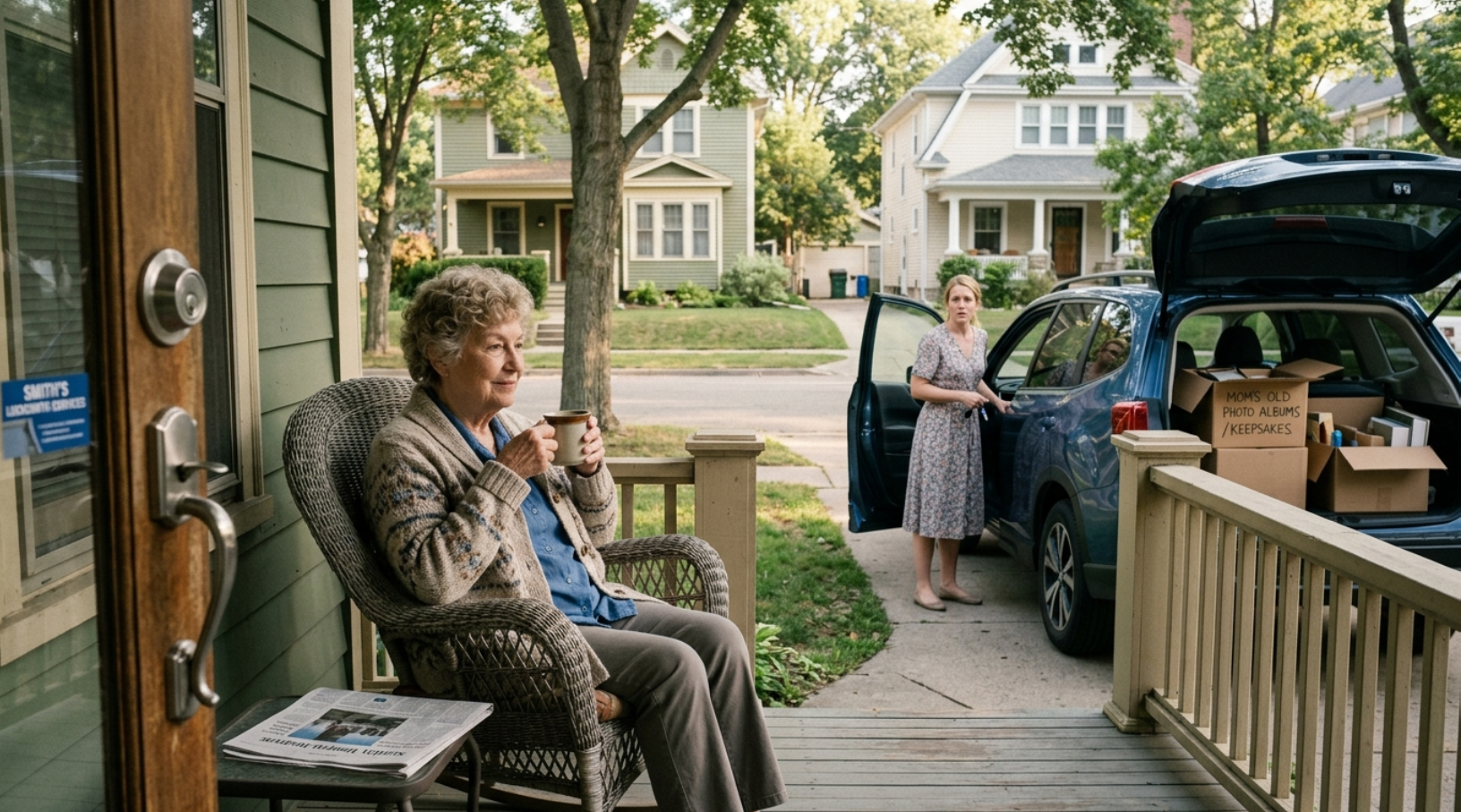
I was watching the SUV.
The back hatch remained open.
And beneath the luggage, I could see a cardboard banker’s box.
On top of it was a folder.
My name was written across the folder.
ELEANOR WHITAKER — OAKMONT
My stomach dropped.
Oakmont.
The care facility Chloe had mentioned to Rachel.
The place they had planned to send me without my permission.
I put my coffee down.
“Chloe.”
She turned.
“What?”
“What is in your car?”
“Nothing.”
“You have four suitcases and a box labeled with my name.”
Her eyes flicked toward the SUV.
For the first time since she had arrived, she looked genuinely frightened.
Then she slammed the rear hatch shut.
“Those are my things.”
“Then why does one say Eleanor?”
“You’re imagining things.”
“No,” I said quietly.
“I am finally seeing things clearly.”
She stared at me.
I could almost see her calculating.
For four years, she had depended on my hesitation.
She had counted on my embarrassment.
She had assumed that because I was eighty-one, I would rather avoid a confrontation than expose my own family.
But she had forgotten something.
An old woman can become very dangerous to people who have mistaken her patience for surrender.
I reached into the pocket of my cardigan and pulled out my phone.
“I think we should wait for the police.”
Chloe’s face went pale.
“Police?”
“Yes.”
“You called the police?”
“Not yet.”
I pressed the screen.
“But I can.”
She took one step toward me.
“You don’t understand what you’re doing.”
“I understand perfectly.”
“You’re humiliating your own family.”
I almost laughed.
“My family humiliated itself.”
She shook her head.
“This is ridiculous. I’m your daughter-in-law.”
“And I am the owner of this house.”
She opened her mouth.
Nothing came out.
Then she whispered, “You can’t do this to Mitchell.”
I looked directly into her eyes.
“I didn’t do anything to Mitchell.”
“You’re destroying his life.”
“No.”
My voice remained calm.
“I’m stopping you from destroying mine.”
She stared at me for several seconds.
Then her phone rang.
She answered immediately.
“Mitchell?”
I could hear his voice faintly through the speaker.
“What happened?”
Chloe looked at me.
“She changed the locks.”
There was silence.
Then Mitchell said something.
Chloe’s expression changed.
“What do you mean you can’t come home?”
Another pause.
“Mitchell, she’s confused.”
I closed my eyes.
That word.
Confused.
They had used it so often that it had become a weapon.
Every time I disagreed with them, I was confused.
Every time I remembered something they wanted forgotten, I was confused.
Every time I refused to sign something, I was confused.
But that morning, I finally understood what they had been doing.
They weren’t trying to convince me that I was confused.
They were trying to convince everyone else.
Chloe ended the call.
“What did he say?” I asked.
“He’s coming.”
“When?”
“He’ll be here.”
I nodded.
“Then we can all talk.”
She stared at me as though she had expected me to scream.
I didn’t.
Instead, I sat back down in my chair.
That seemed to disturb her more than anger would have.
She remained beside her SUV for several minutes.
Then she got into the driver’s seat.
She started the engine.
I watched her carefully.
“Where are you going?”
“To get Mitchell.”
“You just said he was coming.”
“He needs to understand what you’ve done.”
“Then stay.”
She didn’t answer.
She backed the SUV out of the driveway.
I watched until it disappeared around the corner.
Then I called Sarah.
“She was moving my things.”
There was a pause.
“What things?”
“My medical records. Personal documents. Clothes. And something labeled Oakmont.”
Sarah became very quiet.
“Did you photograph everything?”
“I saw it after she closed the hatch.”
“Did you get a picture?”
“No.”
“That’s okay. Don’t confront her again. Stay inside.”
“Sarah?”
“Yes?”
“I think there is more.”
“I know.”
Her voice was different now.
More serious.
“I’ve been thinking the same thing.”
“What do you mean?”
“Your daughter-in-law didn’t prepare for you to sign documents.”
I waited.
“She prepared for you to disappear.”
The words settled heavily in the room.
I looked around my living room.
At Arthur’s handmade hutch.
At the framed photograph of Mitchell as a boy.
At the old brass clock Arthur had bought me on our tenth anniversary.
This was my home.
Forty-nine years of memories.
And someone had been planning how to remove me from it as if I were an unwanted piece of furniture.
Sarah continued.
“I need you to do something for me.”
“What?”
“Go to your bedroom.”
I slowly stood.
“Open the bottom drawer of your nightstand.”
I walked down the hallway.
My legs were trembling.
I opened the drawer.
“There’s an envelope inside,” Sarah said.
I found it.
It was sealed.
“What is it?”
“Open it.”
Inside was a copy of my most recent bank statement.
My eyes couldn’t read the numbers clearly, so I called Margaret.
She arrived twenty minutes later.
She brought her reading glasses and her handbag and walked into my house without asking whether I needed help.
She had known me since we were seventeen.
She knew the difference between helping me and taking control of me.
She sat beside me at the dining table.
“Give it to me.”
I handed her the statement.
She read silently.
Then she stopped.
“What?”
She looked up.
“Eleanor.”
“What?”
“There was a withdrawal.”
“How much?”
Margaret swallowed.
“Thirty-eight thousand dollars.”
The room seemed to tilt.
“When?”
“Three weeks ago.”
I stared at her.
“That can’t be right.”
She turned the paper toward me.
The transaction was clearly listed.
A cashier’s check.
Thirty-eight thousand dollars.
Payable to a company I had never heard of.
“What’s the company?” I asked.
“Pinecrest Senior Placement Services.”
I felt cold.
“Oakmont?”
Margaret nodded slowly.
“It appears connected.”
My hand tightened around the edge of the table.
“I didn’t authorize that.”
“I know.”
Sarah was still on the phone.
“Eleanor, listen carefully.”
I put the phone on speaker.
“The payment may have been made using an account Chloe had access to,” Sarah said. “That’s why I asked you to review your banking records.”
“But how could she withdraw that much?”
“If she had access to your account credentials, she may have attempted to make the transaction appear authorized.”
Margaret looked at me.
“What about your other accounts?”
I shook my head.
“I don’t know.”
Sarah answered immediately.
“That’s what we’re checking.”
She told us to stay at the house.
She would contact the bank.
She would also send an investigator to retrieve copies of the documents connected to Oakmont.
Then she said something that made my blood run cold.
“Eleanor, there is one more thing.”
“What?”
“The affidavit Mitchell signed.”
“Yes?”
“It wasn’t the only document.”
I looked at Margaret.
“What else?”
Sarah paused.
“There is a draft petition for emergency guardianship.”
My chest tightened.
“What does that mean?”
“It means someone was preparing to ask a court to appoint a guardian over you.”
Margaret’s face hardened.
“Who?”
Sarah’s answer was quiet.
“Chloe.”
I closed my eyes.
I had suspected it.
But hearing it made it real.
“What would happen if the court approved it?”
Sarah didn’t soften the answer.
“You could lose control over your finances, your property, and many personal decisions.”
“And the house?”
“If the guardian had authority over your assets, the situation could become very complicated.”
I looked around the room.
So that was the plan.
First, convince everyone I was confused.
Then get guardianship.
Then move me somewhere.
Then sell the house.
And all of it could happen while I sat quietly believing my family was simply trying to help me.
I suddenly understood the suitcases.
They weren’t coming for a weekend.
They were coming to move me.
Permanently.
Margaret reached across the table and took my hand.
“You’re not alone.”
I looked at her.
“I know.”
And for the first time in months, I believed it.
Two hours later, a police cruiser pulled into my driveway.
I recognized the officer immediately.
Detective James Porter.
Sarah had contacted him because the situation involved suspected financial exploitation and forged legal documents.
He was accompanied by another officer.
They entered the house and spoke quietly with Sarah.
Then Detective Porter sat across from me.
“Mrs. Whitaker, I want to make sure you understand that you’re not being treated as a suspect.”
“I know.”
“We’re investigating possible financial exploitation.”
“I understand.”
“And we need your statement.”
I nodded.
He opened a notebook.
“Tell me everything from the beginning.”
So I did.
I told him about the mail.
The documents.
The doctor’s appointments.
The conversations.
The kitchen.
The affidavit.
The planned placement at Oakmont.
The money.
Everything.
When I finished, Detective Porter sat silently for several seconds.
Then he asked:
“Do you have any reason to believe your son knew what was happening?”
I looked down at my hands.
That was the question I had been avoiding.
“I don’t know.”
“You believe he signed documents.”
“Yes.”
“Do you know whether he understood them?”
“No.”
“Did he ever discuss your health or finances with you?”
“Not honestly.”
Detective Porter wrote something down.
“That’s important.”
“Why?”
“Because there is a difference between knowingly participating and signing documents someone else prepared.”
I nodded.
“I don’t want my son destroyed.”
Detective Porter looked at me.
“Mrs. Whitaker, protecting your son and protecting yourself are not mutually exclusive.”
That sentence stayed with me.
For years, I had believed I had to choose.
Either I protected Mitchell or I protected myself.
Maybe I had been wrong.
Maybe protecting myself was the only chance I had of finding out whether there was still a son underneath the man Chloe had helped create.
At 5:17 that afternoon, Mitchell finally arrived.
His car stopped at the curb.
He didn’t get out immediately.
He sat behind the wheel for almost a full minute.
Then the driver’s door opened.
He walked toward the house.
He looked exhausted.
Not angry.
Not confident.
Exhausted.
He stopped at the edge of the driveway when he saw the police cruiser.
His eyes found mine.
“Mom?”
I stood on the porch.
“Hello, Mitchell.”
He looked at the new locks.
Then at the officers.
Then back at me.
“What happened?”
I stared at my son.
The little boy who had once taken his first steps across this floor.
The teenager who used to crawl into my bed after thunderstorms.
The young man Arthur and I had sacrificed everything to raise.
And now I had to ask him the question that had been haunting me for months.
“Did you sign documents saying I’m mentally incompetent?”
His face changed.
“What?”
“Did you?”
He looked at Chloe’s SUV.
“She told me you were getting worse.”
“That wasn’t my question.”
He swallowed.
“I signed some papers.”
“What papers?”
“I don’t know.”
My heart broke.
“You don’t know?”
“She said they were necessary.”
“Necessary for what?”
“She said the doctor recommended them.”
I looked at Sarah.
Then back at Mitchell.
“Which doctor?”
He didn’t answer.
“Mitchell.”
“I don’t know.”
“Did you ever speak to the doctor?”
Silence.
“No.”
“Did you ever see a medical report saying I was incompetent?”
He looked down.
“No.”
I felt tears burning behind my eyes.
“Then why did you sign it?”
His voice cracked.
“Because I trusted my wife.”
The sentence was almost a whisper.
I closed my eyes.
And suddenly, for the first time, I saw something I hadn’t allowed myself to see before.
Mitchell wasn’t standing there like a man who had planned to take his mother’s house.
He was standing there like a man who had just realized he might have helped someone take it.
Then Chloe arrived.
Her SUV stopped abruptly behind his car.
She got out.
The moment she saw the police, she froze.
“What’s going on?”
Detective Porter stepped forward.
“Mrs. Whitaker has made a report concerning suspected financial exploitation and fraudulent legal filings.”
Chloe’s face went blank.
“That’s absurd.”
Detective Porter remained calm.
“We’ll discuss that at the station.”
“I’m not going anywhere.”
“You’re not under arrest at this moment.”
She looked at Mitchell.
“Tell them.”
Mitchell didn’t move.
“Tell them what?” he asked.
“That your mother is confused.”
He stared at her.
For several seconds, neither of them spoke.
Then Mitchell said something I had never expected to hear from him.
“Chloe… were you going to put Mom in a care facility?”
Her expression changed.
“No.”
“You told me she wanted to go.”
“I said she needed help.”
“You told me she asked about Oakmont.”
“She did.”
I spoke from the porch.
“No, I didn’t.”
Chloe turned toward me.
“You don’t remember.”
“I remember enough.”
Mitchell looked between us.
“Why were her things packed in your car?”
Chloe’s mouth opened.
Then closed.
She had no answer.
And in that silence, my son finally understood that the story he had been given was falling apart.
Detective Porter stepped closer.
“Mrs. Whitaker, we need to speak with you privately.”
Chloe’s face tightened.
“This is a family matter.”
“No,” Detective Porter said.
“It stopped being only a family matter when money was transferred from an elderly person’s account without her authorization.”
Chloe’s eyes darted toward Mitchell.
“Mitchell.”
He didn’t look at her.
She whispered his name again.
“Mitchell.”
He finally turned.
“What did you do?”
Her face crumpled.
“I was trying to help.”
“No.”
His voice was quiet.
“You were trying to take her house.”
She started crying.
I expected to feel satisfaction.
Instead, I felt tired.
Deeply tired.
Because the truth was finally coming out, and there was nothing triumphant about watching your own family collapse.
Detective Porter asked Chloe to accompany him for questioning.
She resisted at first.
Then she looked at Mitchell.
He wouldn’t meet her eyes.
She left with the officers.
The driveway became quiet.
Mitchell remained standing there.
For several minutes, neither of us spoke.
Finally, he looked at me.
“Mom.”
“Yes?”
“I’m sorry.”
I wanted to say it was okay.
I wanted to tell him he had been manipulated.
I wanted to make this easier for him.
But I couldn’t.
Not yet.
“I’m not ready to forgive you.”
He nodded.
“I understand.”
“But I’m glad you came.”
His eyes filled with tears.
“I should have listened to you.”
“Yes.”
That was all I could say.
Because sometimes the truth doesn’t need a speech.
Sometimes it only needs to be spoken once.
And for the first time in four years, my son stood in front of me without Chloe standing between us.
He looked older.
Smaller.
Almost like the boy who used to run into my arms after falling off his bicycle.
I wanted that boy back.
But I knew wanting it didn’t mean I could erase everything that had happened.
Healing would have to be earned.
And that would take time.
Much more time than either of us realized.
Because the next morning, Sarah called me with news that changed everything again.
The bank had found five additional withdrawals.
And one of them had been made six months earlier.
It wasn’t connected to Oakmont.
It wasn’t connected to Chloe.
It was connected to someone whose name I had not heard in years.
Someone who knew Arthur.
Someone who knew exactly how much my house was worth.
And someone who, according to the bank records, had been receiving money from my accounts long before Chloe ever started talking about assisted living.
Sarah said only four words before I asked her to repeat them.
“Eleanor, there’s another person.”
And suddenly I realized Chloe’s betrayal might not have started with Chloe at all.
PART 4
The name Sarah gave me was one I hadn’t heard in nearly twenty years.
“Daniel Whitmore.”
I stared at the phone.
For a moment, I couldn’t breathe.
“Daniel?”
“Yes.”
“That can’t be right.”
“I thought you might say that.”
Margaret was sitting across from me at the kitchen table. She watched my face carefully.
“Who is Daniel?” she asked.
I swallowed.
“Arthur’s business partner.”
Margaret’s eyebrows rose.
“I thought Arthur’s business ended when he retired.”
“It did.”
“Then why would he be receiving money from your account?”
“That,” I whispered, “is what I want to know.”
Sarah explained that the bank had traced several suspicious transfers to an account connected to a consulting company Daniel had created years ago.
The first transfer had happened six months before Chloe ever moved into my house.
The most recent had happened only eleven days earlier.
“Could Chloe have made those transfers?” I asked.
“Possibly,” Sarah said. “But we don’t know yet.”
“And Daniel?”
“We’re investigating whether he authorized or received them knowingly.”
I looked toward the window.
Outside, the morning sunlight fell across the backyard where Arthur had planted two peach trees nearly forty years earlier.
One of them was still alive.
The other had died years ago.
Arthur always used to say that trees taught people something important.
“Nothing stays exactly as it was,” he would tell me.
At eighty-one, I finally understood.
Neither did families.
Neither did houses.
Neither did people.
But some things could still be saved.
I just didn’t know yet whether my family was one of them.
That afternoon, Sarah came to my house with a thick folder.
She placed it on the dining table.
“This is everything we’ve found so far.”
I looked at the folder.
“How bad is it?”
She sat down.
“That depends on what we discover next.”
Margaret poured tea.
Sarah opened the first document.
“These payments started six months before Chloe and Mitchell moved in.”
I frowned.
“But Chloe didn’t have access to my finances then.”
“Are you certain?”
“I never gave her access.”
Sarah nodded.
“Then someone else did.”
We went through the records one by one.
The first transfer was $8,500.
The second was $12,000.
Then $7,300.
Then $15,000.
Small enough individually that I might not have noticed.
Large enough collectively to change my life.
I remembered those years.
The repairs on the roof.
Arthur’s medical expenses before he died.
My savings.
My retirement.
The money I had carefully accumulated because I had always feared becoming dependent on anyone.
Someone had been slowly draining it.
And I hadn’t noticed.
Not because I was incapable.
Because I trusted the wrong people.
Sarah turned another page.
Then she stopped.
“This one is different.”
“What is it?”
She handed me the document.
It was an old power of attorney.
My name was at the bottom.
My signature appeared beneath it.
I stared.
“I never signed this.”
Sarah nodded.
“I know.”
“When is it dated?”
“Twenty-one years ago.”
Margaret leaned forward.
“Who was it given to?”
Sarah looked at me.
“Daniel Whitmore.”
The room went silent.
I felt as though someone had opened a door inside my memory.
Suddenly I remembered.
Arthur had been sick.
His business had been struggling.
Daniel had offered to help manage certain financial matters.
Arthur trusted him.
So did I.
We had signed paperwork.
Or at least I thought we had.
But this document gave Daniel far more authority than I remembered.
“How did this remain active?”
Sarah explained that the document should have been reviewed after Arthur’s death, but apparently nobody had formally revoked it.
My hands began to shake.
“So Daniel still had access?”
“Potentially.”
“Could he have authorized the withdrawals?”
“Yes.”
“Could Chloe have found the document?”
“Possibly.”
I closed my eyes.
And suddenly the entire story changed.
Chloe had not necessarily created the plan.
She might have discovered an existing weakness.
Daniel might have seen an opportunity.
And Mitchell might have been the easiest person to manipulate.
Three people.
Three different motives.
One house.
Mine.
The next morning, Daniel called.
I almost didn’t answer.
But Sarah had instructed me to document every communication.
So I pressed the button.
“Hello?”
“Eleanor.”
His voice sounded exactly the same.
Smooth.
Friendly.
Almost warm.
“It’s been a long time.”
“Yes.”
“I heard there was some trouble.”
“Where did you hear that?”
A pause.
“People talk.”
I looked at Sarah.
She was sitting across from me, silently signaling me to continue.
“What do you want, Daniel?”
“I want to help.”
“You’ve already helped yourself to enough of my money.”
Silence.
Then he sighed.
“Eleanor, I think you’re confused about those transactions.”
The word hit me like a slap.
Confused.
Again.
I almost laughed.
“I’m not confused.”
“I understand you’re upset.”
“No. You don’t.”
I could hear him breathing.
“You know what I remember most about Arthur?”
“What?”
“He trusted you.”
Daniel didn’t respond.
“He believed you were his friend.”
“I was.”
“Then why did you take money from me?”
“I didn’t.”
“The bank says otherwise.”
“You don’t understand how those accounts were structured.”
“I understand enough.”
His voice became colder.
“You should really speak with your son.”
“My son has nothing to do with your transfers.”
“Are you sure?”
I looked at Sarah.
She immediately wrote something on a notepad.
KEEP HIM TALKING.
So I did.
“Why would Mitchell be involved?”
“I didn’t say he was.”
“You just suggested it.”
“I think you’re making assumptions.”
“Then explain the money.”
Another silence.
Finally, Daniel said something that changed everything.
“Ask your husband.”
I froze.
“My husband is dead.”
“I know.”
“Then what does that mean?”
He ended the call.
I stared at the phone.
Sarah immediately asked, “What did he say?”
I repeated it.
She became very still.
Then she said:
“We need to find out exactly what happened before Arthur died.”
Margaret helped me search through old boxes in the attic.
Arthur hated throwing anything away.
Receipts.
Letters.
Old calendars.
Business records.
Photographs.
Tax documents.
Everything had been stored in boxes with his handwriting on them.
After several hours, Margaret pulled out a battered blue folder.
“Eleanor.”
I turned.
“What?”
“This says Daniel.”
My heart started pounding.
We opened it.
Inside were copies of business agreements.
Old bank correspondence.
And a letter dated three months before Arthur died.
The handwriting was Arthur’s.
My hands shook as Margaret read it aloud.
Daniel,
I know something is wrong with the accounts.
I don’t know whether you made the withdrawals or whether someone else is using your authority.
I have asked the bank for complete records.
If something happens to me before this is resolved, Eleanor must be protected.
She trusts you.
Please don’t make me regret that.
Margaret stopped reading.
I stared at the page.
“Arthur knew.”
Sarah took a photograph of the letter.
“What else is in the folder?”
We kept searching.
At the bottom was another envelope.
It had never been opened.
My name was written on it.
Eleanor — Read this if I am gone.
My heart broke before I even opened it.
Margaret moved closer.
I unfolded the letter.
Arthur’s handwriting filled the page.
He wrote about the business.
About Daniel.
About money he believed was missing.
But then he wrote something else.
Something that made me cry.
He said he had worried that if he died before resolving the matter, Daniel might try to control my finances.
He wrote that he had arranged for another attorney to review everything.
And then he wrote:
Eleanor, if you ever feel like someone is trying to convince you that you are incapable of managing your own life, believe yourself first.
Age does not erase a person’s judgment.
Never let anyone make you ashamed of growing old.
You have spent your whole life caring for other people.
Promise me that if I’m gone, you will learn to care for yourself with the same determination.
I couldn’t read anymore.
I pressed the letter against my chest.
Arthur had been gone for years.
But somehow, that morning, it felt as though he had reached across time and put his hand on my shoulder.
Sarah took the letter to investigators.
Within days, everything began unraveling.
The original attorney Arthur had contacted was still alive.
He was ninety-two.
His name was Harold Bennett.
When Sarah found him, he remembered Arthur.
More importantly, he remembered Daniel.
Harold had kept copies of the files.
According to those records, Arthur had suspected Daniel of improperly transferring money from a business account.
But Arthur had died before the investigation was completed.
After Arthur’s death, Daniel had presented himself as a trusted adviser.
And because I was grieving, I had accepted his help.
Eventually, he disappeared from my life.
Or so I thought.
He had never completely disappeared.
He had simply become invisible.
And when Chloe began looking for ways to control my property, she discovered the old financial authority.
The investigation revealed something even worse.
Chloe had contacted Daniel nearly a year before the Sunday when I changed the locks.
Phone records showed dozens of calls.
Emails showed conversations about my house.
One message from Chloe read:
If she won’t cooperate, we need another way.
Another message from Daniel answered:
There is a legal route. Her age and medical situation make it easier than fighting her directly.
I read that message three times.
The word her suddenly felt like an object.
Not a person.
Not a mother.
Not a widow.
Just an obstacle.
The case eventually became bigger than I had expected.
Daniel was questioned about the financial transfers.
Chloe was investigated for suspected financial exploitation and fraudulent documents.
The guardianship petition was withdrawn.
The suspicious transactions were frozen.
And the money that remained was placed under strict protection.
But the most painful conversation happened at my kitchen table.
Mitchell sat across from me.
No Chloe.
No lawyer.
No excuses.
Just my son and me.
He looked older than he had a month earlier.
“I didn’t know,” he said.
“I know.”
“I swear, Mom.”
“I believe you didn’t understand everything.”
He looked down.
“But I signed it.”
“Yes.”
“I should have asked questions.”
“Yes.”
His eyes filled.
“Can you ever forgive me?”
I took a long breath.
“I don’t know.”
He nodded.
“I understand.”
“But I want to try.”
He looked up.
I continued.
“Forgiveness doesn’t mean pretending it didn’t happen.”
“I know.”
“It means we decide what happens next.”
He wiped his eyes.
“What happens next?”
“You rebuild trust.”
“How?”
“Slowly.”
He nodded.
“I’ll do that.”
I believed him.
Not completely.
Not yet.
But enough to give him a chance.
Six months later, the house felt different.
Not because the walls had changed.
Because I had.
The locks were still new.
Sarah had helped me create a new estate plan.
My financial accounts were protected.
My medical directives were updated.
And every important document was stored where only I could access it.
I hired someone to help with housekeeping twice a week.
I started attending a senior writing group at the community center.
And every Wednesday afternoon, Margaret still came for tea.
Mitchell visited every Sunday.
He never asked about money.
He never opened my mail.
He never answered questions directed at me.
Sometimes we sat quietly.
Sometimes we talked about Arthur.
Sometimes Mitchell told me stories about his childhood that I had forgotten.
Slowly, painfully, we began becoming mother and son again.
Not the mother and son we had been before.
Something new.
Something more honest.
One Sunday afternoon, Mitchell stood beside the front door.
“I brought something.”
He handed me a small wooden box.
I recognized it immediately.
Arthur had built it.
“Where did you find this?”
“In storage.”
I opened it.
Inside was an old brass key.
My original house key.
The one Arthur had given me in 1974.
I held it in my palm.
Mitchell smiled sadly.
“I thought you should have it.”
I looked at the new lock.
Then at the old key.
Two keys.
Two versions of my life.
One represented the woman who had once believed that home meant protecting everyone else.
The other represented the woman who had finally learned that home also meant protecting herself.
I closed my fingers around the old key.
“Thank you.”
Mitchell hugged me.
This time, I hugged him back.
A year after the Sunday I changed the locks, I stood on the front porch again.
It was 9:15 in the morning.
The same time.
The same porch.
The same house.
But I was not the same woman.
The peach tree in the backyard had blossomed.
Pink flowers covered the branches.
Margaret was sitting beside me with her tea.
“You ever think about selling?” she asked.
I smiled.
“No.”
“Why not?”
I looked toward the front door.
“Because Arthur and I built this place together.”
Then I thought about everything that had happened.
The betrayal.
The fear.
The legal battle.
The money.
My son’s mistake.
Chloe’s lies.
Daniel’s greed.
And the one thing none of them had understood.
The house had never been the most valuable thing I owned.
My voice was.
My choices were.
My ability to say no was.
My right to decide what happened to my own life was.
I took a sip of coffee.
Margaret smiled.
“You know what I think?”
“What?”
“You finally stopped apologizing for being old.”
I laughed softly.
“Maybe.”
“No,” she said. “You did.”
I looked at my hands.
They were wrinkled.
Veined.
A little shaky.
But they were still mine.
And that mattered.
A car pulled into the driveway.
Mitchell stepped out carrying a box.
He waved.
“Mom!”
I smiled.
“What did you bring?”
“Peach pie.”
Margaret raised an eyebrow.
“Store-bought?”
Mitchell laughed.
“I tried making one.”
I shook my head.
“Then we’d better call the fire department.”
He laughed.
For the first time in a very long time, the sound of laughter filled the house again.
Not because I had forgotten what happened.
Because I had survived it.
And as I watched my son walk toward the porch, I realized something I wished someone had told me years earlier:
Growing old does not mean surrendering your voice.
Needing help does not mean giving away your independence.
And loving your family does not require allowing them to hurt you.
Sometimes the strongest thing an old woman can do is say:
This is my home.
This is my life.
And I still get to decide what happens next.
I looked at the new lock on my front door.
Then I smiled.
Because the lock had never really been about keeping people out.
It had been about finally understanding that I had the right to decide who I let in.