PART 3
I had destroyed my own son.
Bella was eleven now.
She had grown taller.
Her hair had become longer.
She still laughed loudly.
She still loved cartoons and strawberry milkshakes.
She still slept with the same stuffed rabbit she had owned since she was five.
And because we had believed her two years earlier, everyone in our family treated her like fragile glass.
Nobody questioned her.
Nobody challenged her.
Nobody wanted to risk making her feel unsafe.
If she said she did not want to go somewhere, we stayed home.
If she said someone made her uncomfortable, we avoided that person.
If she said she remembered something differently, we accepted it.
I thought we were protecting her.
I did not realize we were also teaching her that nobody would ever ask her to explain anything.
Then, one Saturday afternoon, everything changed.
Bella asked me if we could go to the mall.
She wanted a new pair of shoes for school.
I remember laughing because she had already owned enough shoes to fill half a closet.
“Why do you need another pair?”
“Because everybody has the white ones.”
“You said that last month.”
“This time it’s different.”
I smiled.
“Fine. Give me ten minutes.”
She ran upstairs.
Ernest was in the garage working on his car.
I went into the kitchen to get my purse.
And then I heard the crash.
It sounded like metal hitting concrete.
Then silence.
Then Bella screamed.
“Mom!”
I dropped everything.
I ran outside.
She was lying beside the driveway.
Her bicycle was twisted underneath her.
There was blood on her forehead.
Her left leg was bent at an angle that made my stomach turn.
For one terrible second, I could not understand what I was seeing.
Then I screamed for Ernest.
He came running from the garage.
“Oh my God.”
I dropped beside Bella.
“Baby! Baby, look at Mommy!”
Her eyes fluttered.
“Mom…”
“I’m here.”
“It hurts.”
“I know.”
“Mommy, it hurts so bad.”
Ernest called 911.
I held her hand while we waited.
She kept asking me the same question.
“Am I going to die?”
“No.”
I said it immediately.
“No, sweetheart. You’re not going to die.”
I did not know whether that was true.
But I could not tell my eleven-year-old daughter that I was terrified.
The ambulance arrived.
Everything happened quickly after that.
Paramedics.
Questions.
Blood pressure.
Oxygen.
A stretcher.
Hospital doors.
Doctors running.
Nurses moving around us.
And then the words I will never forget.
“Her kidneys aren’t responding properly.”
I stared at the doctor.
“What does that mean?”
“It means the trauma may have caused severe damage.”
“Can you fix it?”
“We’re doing everything we can.”
“Then do it.”
My voice broke.
“Please.”
The doctor looked at Ernest and me.
“There is another concern.”
“What?”
“We need to monitor her kidney function closely.”
Hours passed.
Then a day.
Then another.
Bella’s condition worsened.
Her body was struggling.
The doctors tried medication.
They tried supportive treatment.
They monitored her blood work.
But eventually, the transplant team became involved.
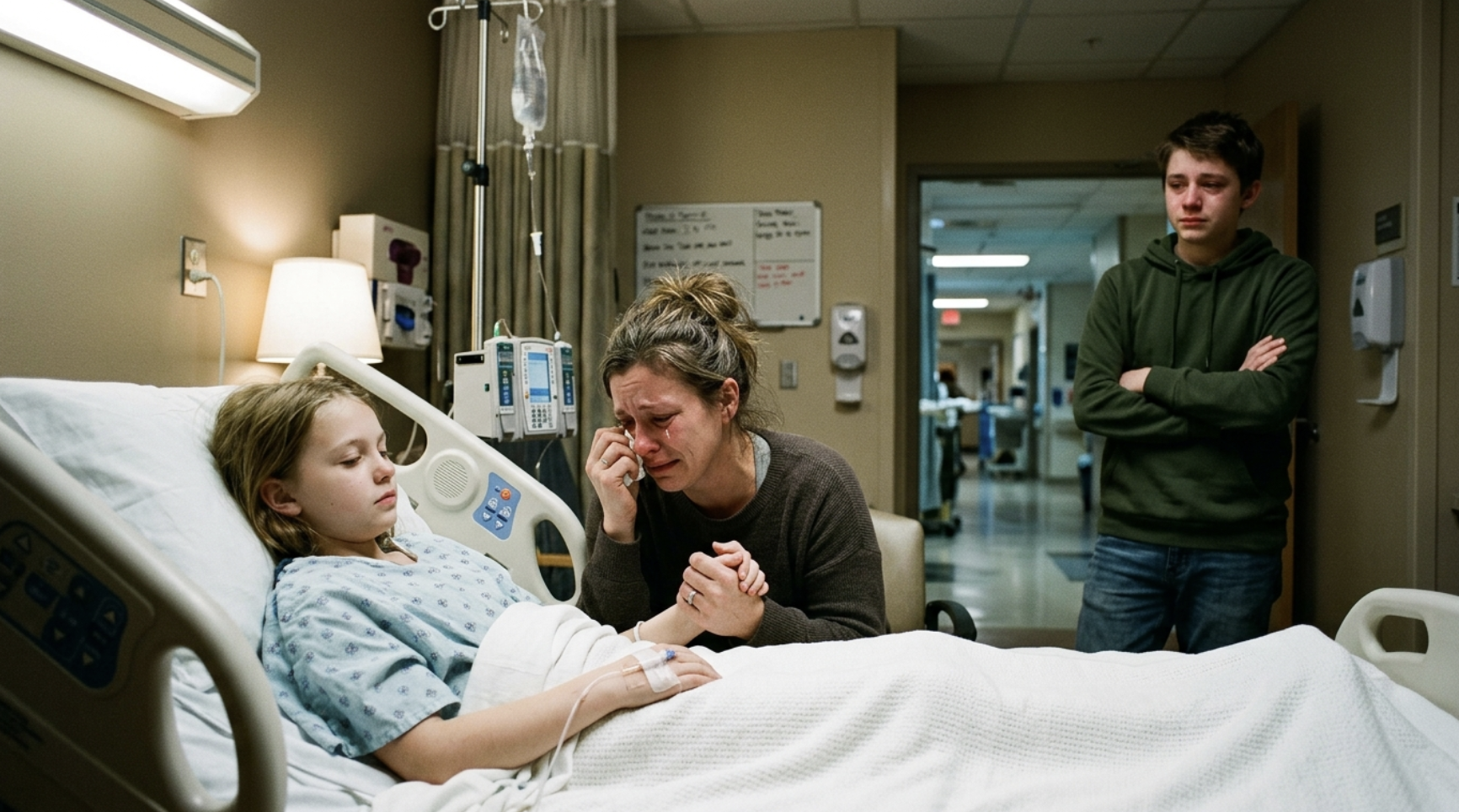
I remember sitting in that hospital room with a paper cup of coffee between my hands.
I had not slept.
Ernest sat beside me with his elbows on his knees.
The doctor came in carrying a folder.
He sat across from us.
“I need to talk to you about transplantation.”
My fingers tightened around the cup.
“What?”
“Bella’s kidney function has deteriorated significantly.”
“No.”
“If this continues, she may need a transplant.”
My heart began pounding.
“But she’s only eleven.”
“I know.”
“She was riding a bicycle three days ago.”
“I know.”
“She was fine.”
“I understand.”
I started crying.
“You have to save her.”
“We are trying.”
“Then find a kidney.”
The doctor paused.
“A living related donor can sometimes be the best option when compatible.”
Ernest looked at him.
“Family?”
“Yes.”
I stared at the doctor.
“Who?”
“Parents, siblings, certain relatives.”
My stomach dropped.
Siblings.
I immediately thought of Marcus.
The son we had thrown away.
The son whose name we had avoided saying.
The son who had been ten years older than Bella.
The son who had shared half her DNA.
I looked at Ernest.
He looked back at me.
Neither of us spoke.
The doctor noticed.
“Is there a sibling?”
I swallowed.
“Yes.”
“Where is he?”
I lowered my eyes.
“We don’t know.”
The doctor frowned.
“You don’t know where your own son is?”
The question cut deeper than he could possibly understand.
Ernest answered.
“We haven’t spoken to him in two years.”
The doctor looked between us.
“Then we need to find him.”
That was the first time in two years that Marcus’s name was spoken in our home without anger.
And the moment it was spoken, the entire past came crashing back.
His bloodied face.
His clothes on the sidewalk.
His voice.
Mom, please.
I could barely breathe.
But there was no time to mourn what we had done.
Our daughter needed a kidney.
And the person who might be able to save her was the boy we had destroyed.
We began searching.
First, we contacted his old college.
The school told us he had withdrawn shortly after the accusation.
Then we contacted his former roommate.
He had not spoken to Marcus in months.
Then an old professor.
Nothing.
Then one of Marcus’s friends.
Finally, after days of searching, we found something.
A LinkedIn profile.
The name was different.
Marcus had shortened his surname.
But his photograph was unmistakable.
He looked older.
Thinner.
More serious.
There was something in his eyes that I recognized immediately.
He had grown up.
Without us.
His profile showed that he was working for a medical technology company in Minneapolis.
He had completed a degree.
He had received several professional awards.
He had built an entire life while we were pretending he had never existed.
I stared at the screen for nearly ten minutes.
Then I whispered,
“That’s him.”
Ernest looked over my shoulder.
For a long time, neither of us moved.
Then Ernest said,
“Call him.”
My hand shook as I dialed the number listed on the company website.
A receptionist answered.
“Good morning. How can I help you?”
“I need to speak with Marcus.”
“May I ask who’s calling?”
I almost said, “His mother.”
But the words felt too heavy.
“Marissa.”
There was a pause.
“I’m sorry, who?”
“Marissa Rowe.”
The receptionist’s tone changed.
“I’ll see if he’s available.”
The line went silent.
Thirty seconds.
One minute.
Then a man’s voice came through.
“Hello?”
I knew immediately.
My heart stopped.
“Marcus?”
Silence.
Then—
“Mom?”
I covered my mouth.
I had imagined hearing that word a thousand times.
In my dreams.
In the shower.
In the car.
But now that it was real, I couldn’t speak.
“Marcus…”
“What do you want?”
His voice was calm.
Not angry.
That somehow hurt more.
“I need to talk to you.”
“You’re talking.”
“It’s Bella.”
The silence that followed was different.
“What happened?”
I started crying.
“She was in an accident.”
No response.
“She is very sick.”
Still nothing.
“The doctors say she may need a kidney transplant.”
I heard him breathe.
Then he asked,
“Why are you calling me?”
“Because you’re her brother.”
He gave a short, bitter laugh.
“Two years ago, you told me I wasn’t.”
My eyes filled with tears.
“I know.”
“No, Mom.”
His voice became quieter.
“You don’t know.”
I could not answer.
“You don’t know what happened after you closed that door.”
“Marcus…”
“I slept in my friend’s car for three nights.”
My chest tightened.
“I didn’t know.”
“You never asked.”
I closed my eyes.
He continued.
“I lost my scholarship.”
I began crying harder.
“I didn’t know.”
“You never asked.”
Each sentence felt like a blade.
“I worked nights.”
Silence.
“I stopped going to school.”
I could barely breathe.
“I thought about calling you every day.”
My voice cracked.
“Why didn’t you?”
“Because you told me you were done with me.”
I pressed my hand against my chest.
“I’m sorry.”
There was a long silence.
Then he asked,
“Does Bella know you’re calling me?”
I hesitated.
“Yes.”
Another silence.
Finally he said,
“I’ll come.”
I almost collapsed with relief.
“Thank you.”
“But don’t misunderstand me.”
My heart sank.
“I’m coming to see her.”
He paused.
“Not because you deserve my help.”
Then the call ended.
Three hours later, Marcus walked into the hospital.
I almost didn’t recognize him.
He was taller.
His hair was shorter.
He wore a dark jacket and carried a small backpack.
But the moment his eyes met mine, I saw the eighteen-year-old boy standing in our driveway again.
Except now he wasn’t asking me to believe him.
He wasn’t asking for anything.
He looked at me as though I were a stranger.
“Where is she?”
I pointed toward Bella’s room.
He walked past me.
He didn’t hug me.
He didn’t say hello.
He didn’t even look at Ernest.
Inside the room, Bella was awake.
She saw him.
Her face changed instantly.
“Marcus…”
He stopped.
She began crying.
“I’m sorry.”
Marcus stood beside the bed.
He didn’t speak.
Bella covered her face.
“I lied.”
Everything inside me froze.
Ernest’s head snapped toward her.
“What?”
Bella sobbed.
“I lied.”
Marcus looked at her.
For the first time, emotion crossed his face.
Not anger.
Not hatred.
Pain.
Deep, exhausted pain.
“Why?”
Bella couldn’t answer.
“Why did you say I touched you?”
She cried harder.
“I don’t know.”
“You do know.”
She shook her head.
“I was angry.”
“At me?”
“Yes.”
“Why?”
“Because Mommy liked you more.”
My stomach dropped.
Bella continued through her tears.
“Everybody liked you.”
Marcus stared at her.
“I thought Mommy loved you more.”
“That wasn’t true.”
“I knew you were going away to college.”
Her voice trembled.
“I didn’t want you to leave.”
Marcus looked down.
“So you destroyed my life?”
Bella screamed through her tears.
“I didn’t know what would happen!”
The room went silent.
Then Bella whispered,
“I thought Mommy would just be angry with you.”
Marcus closed his eyes.
I stepped forward.
“Marcus…”
He lifted one hand.
“Don’t.”
I stopped.
Bella looked at him.
“I’ve been sorry every day.”
Marcus stared at her for several seconds.
Then he said quietly,
“You’re not the one who destroyed me.”
Bella looked confused.
“Who did?”
He turned toward me.
I felt my heart break before he even spoke.
“She did.”
He pointed at me.
“Mom destroyed me.”
I started crying.
“Yes.”
I whispered.
“I did.”
Marcus looked at me for a long moment.
Then he asked the question I had spent two years avoiding.
“Why didn’t you ask me one question?”
I had no answer.
Not a single one.
He continued.
“You didn’t investigate.”
He looked at Ernest.
“You didn’t protect me.”
Then back at me.
“You didn’t even look at me.”
I lowered my head.
“You just decided I was guilty.”
“I was scared.”
“That doesn’t excuse it.”
“I know.”
“You were my mother.”
“I know.”
“You were supposed to know me.”
I covered my face.
“I should have.”
He looked toward Bella.
Then toward the machines surrounding her.
“I’m willing to get tested.”
Ernest looked shocked.
“You are?”
Marcus nodded.
“For her.”
He paused.
“But if I’m compatible, understand something.”
“What?”
He looked directly at us.
“I will help Bella because she is my sister.”
His voice became colder.
“I am not coming back to this family.”
My heart sank.
“I understand.”
“And after the transplant, don’t call me.”
I nodded through tears.
“I understand.”
He looked at Bella one last time.
Then he walked out.
I wanted to follow him.
I wanted to beg.
But for the first time in two years, I understood that wanting forgiveness did not mean I was entitled to receive it.
And as the hospital door closed behind him, I realized something even worse.
The lie had finally been exposed.
But the truth had come too late to undo what we had done.
Marcus’s blood could possibly save Bella.
But nothing could give him back the two years we had stolen.
And I had no idea that before the next morning came, Marcus would make a decision that would force our entire family—and eventually the entire country—to confront what had really happened that night.
PART 4
At 6:12 the next morning, Marcus left the hospital.
At 6:19, the transplant team confirmed what we had been praying for.
He was a match.
I should have felt relief.
Instead, I felt something close to shame.
Because the person who could save my daughter’s life was the same person whose life I had helped destroy.
The doctor explained everything carefully.
“There are still additional tests we need to complete. Compatibility is only the beginning.”
I nodded.
“Whatever he needs, do it.”
The doctor looked at me.
“Mrs. Rowe, I need you to understand something. He has to consent freely. No pressure from the family.”
“I understand.”
“And if he changes his mind, we cannot force him.”
I looked through the glass toward Bella’s room.
Her little body lay beneath the blankets.
Machines surrounded her.
Her face looked smaller than it had the day before.
“I understand.”
But I didn’t.
Not really.
Because all I could think was:
Please, Marcus.
Please save her.
Please don’t make us pay for what we did by letting her die.
That thought frightened me.
Not because I wanted Marcus to be forced.
But because I realized how easily desperation could turn a person selfish.
For two years, I had refused to question anything.
Now I was terrified that I was about to make the same mistake again.
I found Marcus in the hospital parking garage.
He was sitting alone in his car.
I stood several feet away.
I didn’t approach.
I simply waited.
After a few minutes, he lowered his window.
“What?”
I swallowed.
“I won’t ask you for anything.”
He stared at me.
“I mean it.”
I continued.
“If you don’t want to do this, I won’t blame you.”
His eyes remained fixed on me.
“You’re lying.”
“No.”
“You want me to save her.”
“Yes.”
“You’re terrified she’ll die.”
“Yes.”
“You’re her mother.”
“Yes.”
“And I’m her brother.”
I nodded.
He looked away.
“That’s exactly why I’m doing this.”
My eyes filled with tears.
“Thank you.”
He shook his head.
“Don’t thank me.”
“Why?”
“Because I’m not doing it for you.”
He started the car.
“I’m doing it because Bella is eleven years old.”
Then he drove away.
The tests continued.
Blood work.
Scans.
Psychological evaluations.
Medical examinations.
Every hour felt like a lifetime.
Then, on the third day, the transplant surgeon came to our room.
“He’s approved.”
My knees nearly gave out.
“When?”
“We can schedule the procedure.”
I grabbed Ernest’s hand.
For the first time since the accident, we allowed ourselves to breathe.
But then the doctor added something.
“There is one issue.”
“What?”
“Marcus has asked for complete privacy.”
I nodded.
“Of course.”
“He doesn’t want media involvement.”
“Of course.”
“He doesn’t want his name released.”
“Of course.”
“And he doesn’t want any public statement from the family.”
I looked at Ernest.
We both agreed.
“We won’t say anything.”
The surgery was scheduled.
The night before, I sat beside Bella.
She was awake.
“Mom?”
“Yes?”
“Is Marcus really giving me his kidney?”
I looked at her.
“Yes.”
She began crying.
“Why?”
“Because you’re his sister.”
Bella shook her head.
“I don’t deserve it.”
I couldn’t answer.
Then she whispered,
“Mom?”
“Yes?”
“Do you hate me?”
My heart shattered.
“No.”
“But I lied.”
“Yes.”
“I ruined Marcus’s life.”
I took her hand.
“You were a child.”
“So were you.”
I froze.
She looked at me.
“You were supposed to protect him.”
I had no words.
Bella cried.
“I don’t want to die.”
“I know.”
“But I don’t want Marcus to hurt anymore either.”
I kissed her forehead.
“Neither do I.”
She closed her eyes.
“Mom?”
“Yes?”
“When I get better…”
She swallowed.
“Can I tell everyone the truth?”
I stared at her.
“What do you mean?”
“Everyone.”
She opened her eyes.
“Grandma. Aunt Linda. The neighbors. Everybody who thought Marcus was bad.”
My throat tightened.
“Yes.”
“And if they hate me?”
I wiped her tears.
“Then you’ll have to learn to live with the truth.”
She nodded.
“I want to.”
The next morning, Marcus entered the hospital.
He wore a simple gray sweatshirt.
He looked calm.
Too calm.
I wanted to tell him I was proud of him.
But I didn’t feel I had earned the right.
So I simply said,
“Good morning.”
He nodded.
“Morning.”
Then he walked into the surgical preparation area.
I watched him disappear behind the doors.
I sat beside Ernest.
Neither of us spoke.
Hours passed.
Then the surgeon finally came out.
“The surgery went well.”
I burst into tears.
“And Bella?”
“She is stable.”
I covered my face.
Ernest hugged me.
For the first time in two years, we held each other and cried.
Not because everything was fixed.
It wasn’t.
But because our daughter was alive.
Marcus had saved her.
Days later, Bella woke up.
Her eyes opened slowly.
She looked at me.
“Mom?”
“I’m here.”
“Marcus?”
“He’s recovering.”
“Can I see him?”
The nurse allowed her to visit him once he was stable.
Bella was pushed into his room in a wheelchair.
Marcus was pale.
He looked exhausted.
When he saw her, he smiled faintly.
“Hey, troublemaker.”
Bella immediately began crying.
“I’m sorry.”
Marcus sighed.
“Come here.”
She moved closer.
“I ruined your life.”
“You were a kid.”
“But I lied.”
“Yes.”
“I don’t expect you to forgive me.”
Marcus looked at her.
“Good.”
Bella cried harder.
“But…”
He reached out and touched her hand.
“You’re my sister.”
She looked at him.
“That doesn’t erase what happened.”
“I know.”
“But it means I don’t want you to die.”
Bella smiled through her tears.
“I don’t want you to hate me.”
“I don’t.”
She looked surprised.
“I hate what happened.”
He paused.
“But I don’t hate you.”
That was the first time I saw something change between them.
Not forgiveness.
Not yet.
Something smaller.
A beginning.
But while our family was trying to heal privately, someone discovered the hospital records.
And then everything exploded.
A photograph of Marcus leaving the hospital appeared online.
Someone had identified him.
Then another person posted about the transplant.
Then someone connected his name to the accusation from two years earlier.
By noon, strangers were discussing our family.
By afternoon, people were calling Marcus a hero.
Others were calling us monsters.
And then someone found me.
A reporter contacted me.
“Mrs. Rowe, is it true that your son was accused of abusing your daughter two years ago?”
I didn’t respond.
Another message came.
“Did your family force him out?”
I deleted it.
Then another.
“Why did he agree to donate?”
I turned off my phone.
But the story had already escaped.
That evening, Ernest came into my room.
“You need to see this.”
He handed me his phone.
Marcus had uploaded a video.
I stared at the screen.
My hands began shaking.
The video was only twelve minutes long.
Marcus sat in front of a plain wall.
No dramatic music.
No screaming.
No insults.
Just him.
He looked directly into the camera.
“My name is Marcus Rowe.”
He paused.
“Two years ago, my family accused me of something I did not do.”
My heart sank.
He told the entire story.
Not with exaggeration.
Not with hatred.
Just facts.
He explained how Bella had accused him.
How his father had beaten him.
How his mother had stood there.
How he had been thrown out.
How he had lost his education.
How he had slept in his friend’s car.
How he eventually rebuilt his life.
Then he said something that made me cry.
“I don’t want revenge.”
He looked straight into the camera.
“I don’t want my parents arrested.”
“I don’t want strangers attacking my sister.”
“And I don’t want anyone treating me like a hero because I donated an organ.”
He paused.
“I simply want people to understand something.”
His voice shook.
“An accusation is not proof.”
I covered my mouth.
He continued.
“Children deserve to be believed when they are afraid.”
“But children also deserve adults who ask careful questions before destroying another child’s life.”
He looked down.
“My sister lied.”
“But she was eleven when she told the lie.”
“My parents were adults.”
That sentence destroyed me.
Marcus continued.
“I don’t blame a child for not understanding the consequences of her words.”
“But I cannot pretend my parents’ choices didn’t destroy me.”
The video became silent for several seconds.
Then he said:
“My mother asked me yesterday why I would still save Bella after everything.”
I stared at the screen.
“I told her because Bella is eleven.”
He looked into the camera.
“And because I don’t want another life destroyed just because mine was.”
Then he ended the video.
No dramatic statement.
No revenge.
Just silence.
Within hours, millions of people had seen it.
The internet exploded.
People began searching for our names.
News stations called.
Reporters waited outside the hospital.
Strangers sent messages.
Some demanded that we apologize.
Some said Marcus was brave.
Some argued that we had done what frightened parents might do.
Others said there was no excuse.
I read almost none of it.
Because there was only one thing I could think about.
Marcus had told the truth.
And the truth was enough.
I went to his room.
He was awake.
I stood at the doorway.
“Marcus?”
He looked at me.
“What?”
“I saw your video.”
He nodded.
“I figured you would.”
“I want to apologize.”
He looked away.
“You already did.”
“No.”
I stepped inside.
“I said sorry before because I was scared.”
I swallowed.
“This time I’m saying it because I understand.”
He said nothing.
“I was your mother.”
His eyes filled with tears.
“And I failed you.”
His jaw tightened.
“I should have asked questions.”
“Yes.”
“I should have protected you.”
“Yes.”
“I should have listened to you.”
“Yes.”
“I should have stopped your father.”
Marcus looked at me.
“And I didn’t.”
He turned away.
“I know.”
I cried.
“I can’t give you back those two years.”
“No.”
“I can’t undo what people thought about you.”
“No.”
“I can’t erase what happened.”
“No.”
“So I won’t ask you to forgive me.”
He looked back at me.
That seemed to surprise him.
“I don’t deserve forgiveness just because I’m sorry.”
Marcus remained silent.
I continued.
“If someday you want nothing to do with me, I’ll accept that.”
He looked down at his hands.
“And if someday you want to talk…”
I paused.
“I’ll listen.”
I left before he could answer.
Three days later, Bella was discharged from the hospital.
Marcus stayed longer.
He needed time to recover.
When he finally left, he did not return home.
He returned to Minneapolis.
Before leaving, he gave Bella a small envelope.
“Open it later.”
She hugged him.
This time, he hugged her back.
I watched from a distance.
I wanted to join them.
But I didn’t.
Some boundaries exist for a reason.
Bella opened the envelope after he left.
Inside was a photograph.
It was old.
It showed Marcus holding Bella when she was three.
On the back, he had written:
You were my little sister before the lie, and you’ll always be my little sister after it.
Bella cried for nearly an hour.
Months passed.
Bella recovered.
Her kidney function stabilized.
She returned to school.
But we did not return to our old lives.
There was no pretending.
No pretending the accusation never happened.
No pretending Marcus had simply moved away.
We told the truth.
To our relatives.
To our friends.
To anyone who asked.
Bella eventually stood in front of our extended family and told them everything.
Her voice shook.
But she finished.
“I lied about Marcus.”
Nobody interrupted.
“I thought I was angry because he was leaving.”
She cried.
“But I didn’t understand what would happen.”
Then she looked at me.
“Mom believed me without asking questions.”
I lowered my head.
“And Dad hurt him.”
Ernest began crying.
Bella continued.
“Marcus didn’t deserve any of it.”
That day, our family finally said Marcus’s name without shame.
Not as an accusation.
As a person.
Months later, Ernest and I began counseling.
We needed it.
Not to save our marriage.
Not to make ourselves feel better.
But to understand how fear had turned us into people capable of destroying our own child.
Ernest struggled more than I expected.
One night he said,
“I hit my son.”
I looked at him.
“I know.”
“I can’t forgive myself.”
“I don’t think we should forgive ourselves too quickly.”
He nodded.
“We have to remember.”
“Yes.”
“Because if we forget, we might repeat it.”
I reached for his hand.
That was the first honest thing we had said to each other in a long time.
A year after Bella’s transplant, I received a letter.
There was no return address.
But I knew the handwriting.
Marcus.
I opened it with shaking hands.
It said:
Mom,
I don’t know if I’ll ever be able to call you Mom the way I used to.
But I want you to know something.
I’m okay.
I built a life.
I have good friends.
I have work I love.
I’m not the eighteen-year-old boy standing outside the house anymore.
I stopped reading because my tears blurred the page.
Then I continued.
I still remember what happened.
I probably always will.
But remembering isn’t the same as living inside it.
I’m choosing to live.
Then the final paragraph:
Take care of Bella. Teach her that telling the truth matters. Teach her that fear is not an excuse to stop asking questions. And teach her that when you hurt someone, saying sorry is only the beginning.
—Marcus
I held that letter against my chest.
For the first time in years, I cried without trying to hide it.
Not because I had lost my son.
But because I finally understood that love was not simply protecting the child who cried first.
Love was slowing down.
Listening.
Asking questions.
Looking for truth.
And sometimes, love meant accepting that the person you hurt might never come back.
Two years after Bella’s transplant, we received another letter.
This one contained a photograph.
Marcus had gotten married.
He stood beside a woman I had never met.
They looked happy.
On the back of the photograph, he had written:
I’m not ready for you to meet her yet.
But maybe someday.
It wasn’t forgiveness.
Not completely.
But it was a door.
And I understood that I had no right to push it open.
I could only wait.
Six months later, Bella received a text.
From Marcus.
She ran into the kitchen crying.
“Mom!”
“What happened?”
“He’s coming!”
My heart stopped.
“What?”
“He’s coming home for Thanksgiving.”
I sat down.
I couldn’t speak.
For two years, I had dreamed of that moment.
But now that it was actually happening, I was terrified.
Thanksgiving came.
The doorbell rang at 4:17 p.m.
I stood frozen in the kitchen.
Ernest stood beside me.
Bella ran toward the door.
Then stopped.
She looked at me.
“Do you want to open it?”
I shook my head.
“No.”
She smiled.
“You should.”
I walked toward the door.
My hand trembled as I turned the handle.
Marcus stood outside.
Older.
Calmer.
Different.
But still my son.
For several seconds, neither of us spoke.
Then he looked at me.
“Hi, Mom.”
I started crying.
“Hi.”
He gave me a small smile.
“I thought I’d come home for dinner.”
I nodded.
“You’re welcome here.”
He stepped inside.
I wanted to hug him.
I wanted to hold him like I had when he was a little boy.
But I waited.
He looked at me.
Then opened his arms.
I broke.
I stepped forward and hugged him.
He hugged me back.
Not like nothing had happened.
Not like the past had disappeared.
But like two people who had finally survived it.
Over his shoulder, I saw Bella crying.
Marcus released me.
Then he walked toward her.
Bella hugged him.
And this time, nobody pushed them apart.
Nobody doubted.
Nobody accused.
Nobody was afraid.
There was only a brother and sister standing together.
And a mother watching them with tears in her eyes.
I had once believed that protecting my daughter meant believing her without question.
I was wrong.
Protecting children means believing their pain enough to listen carefully, while loving every child enough to seek the truth before making a judgment that can never be undone.
I had learned that lesson far too late.
Marcus had paid the price for my mistake.
And no apology could ever change that.
But he had survived.
Bella had survived.
And somehow, against every expectation, our broken family had found a way to stop pretending.
We could not rewrite the past.
We could not give Marcus back the years we had taken.
But we could refuse to repeat the same mistake.
That was the beginning of our healing.
Not a perfect ending.
Not a magical one.
A real one.
Because sometimes a good ending isn’t getting back everything you lost.
Sometimes it’s finally becoming honest enough to stop destroying what remains.
And every Thanksgiving after that, there was one empty chair at our table.
Not because Marcus was gone.
But because we kept it empty as a reminder.
A reminder of the boy who had once stood outside our house with a suitcase in his hand, begging his mother to believe him.
A reminder of the years we could never return.
And a reminder that truth should never have to wait until someone is dying before we are willing to listen.
Marcus eventually forgave me.
Not all at once.
Not completely.
But little by little.
And I learned that forgiveness isn’t a door someone owes you.
It’s a gift they may choose to give.
So when Marcus finally called me “Mom” again without hesitation, I didn’t celebrate loudly.
I simply closed my eyes.
And thanked God.
Because I knew exactly how close I had come to losing the right to hear that word forever.
And this time…
I listened.