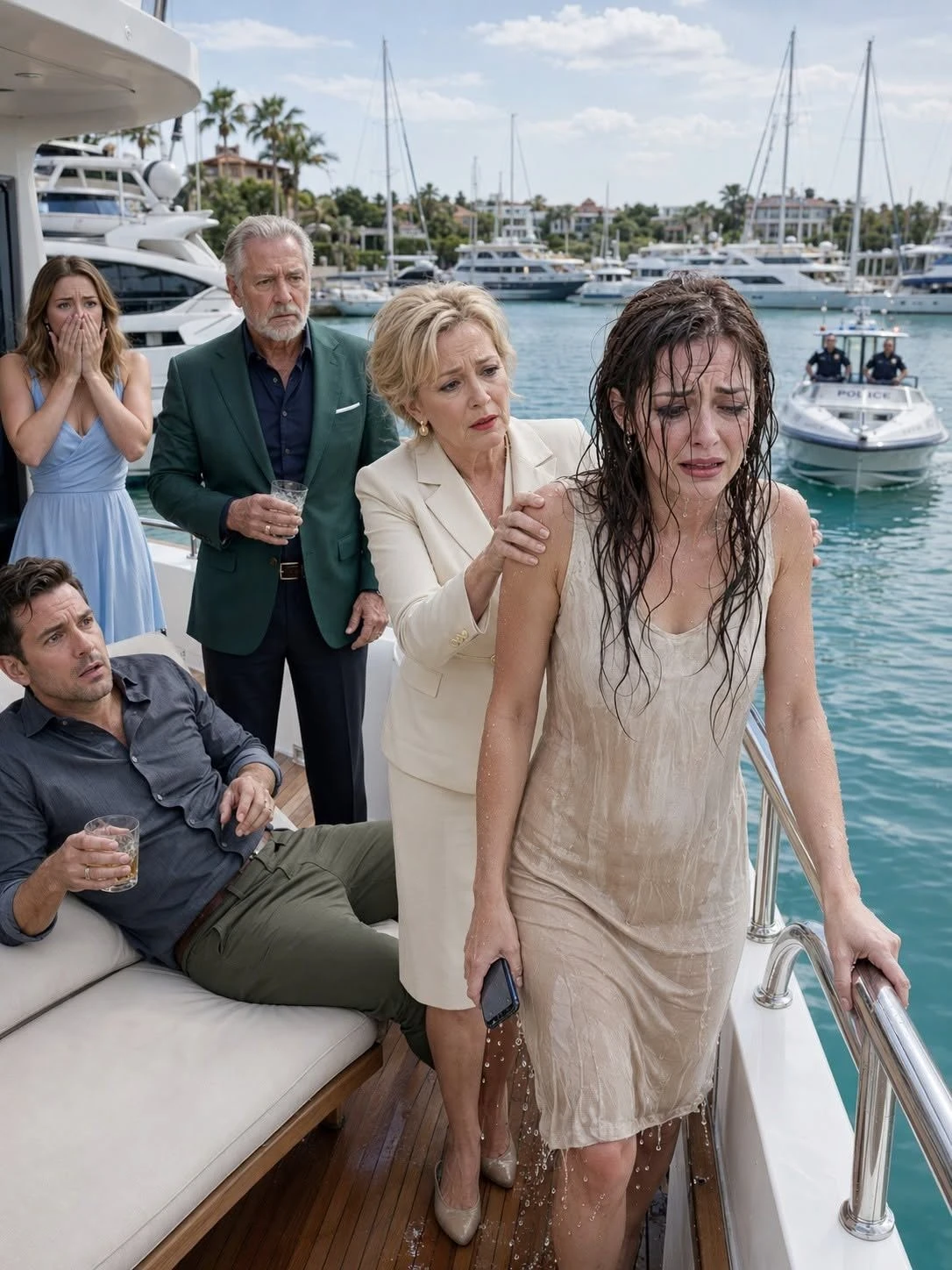
I never told my boyfriend’s snobbish parents that I owned the bank holding their massive debt. To them, I was just a “barista with no future.”
At their yacht party, his mother pushed me toward the edge of the boat and sneered, “Service staff should stay below deck,” while his father laughed, “Don’t get the
furniture wet, trash.” My boyfriend adjusted his sunglasses and didn’t move. Then, a siren blared across the water. A police boat pulled up alongside the yacht… and
the Bank’s Chief Legal Officer stepped aboard with a megaphone, looking directly at me. “Madam President, the foreclosure papers are ready for your signature.”
They mistook silence for weakness seconds before the harbor answered.
The martini hit my knees first, cold and sugary, with olive brine running down my calves and soaking into my sandals. The Atlantic wind slapped salt across my face.
Soft jazz floated from hidden speakers while twelve people in linen and gold watches laughed like humiliation was just another party favor on a white yacht.
“Oops,” Victoria Richardson said, not even pretending she meant it. She tilted the empty glass toward my stained dress and smiled wider when the pale fabric clung to my legs. “You really should watch where you stand, Emily.”
I had been dating Liam for eight months, long enough to know the difference between a family with money and a family terrified of losing the appearance of it. He
liked that I worked the counter some mornings at Rowan Street Coffee, the neighborhood shop my investment fund helped keep open. He called it “adorable.” His
mother called it “proof.” His father called it “what happens when girls don’t plan.”
They never asked why the shop never missed payroll. They never asked who owned the building. They saw an apron once and built an entire version of me around it.
“Clean that up,” Victoria said, flicking two manicured fingers at my dress. “You’re used to mopping floors, aren’t you?”
I looked at Liam.
He was stretched out in a teak lounge chair with mirrored sunglasses on, an imported beer sweating in his hand, and the same lazy smile he used whenever his
mother went too far. He had seen the drink. He had heard the insult. He looked at the harbor instead.
There are people who choose you in private and abandon you in public. They don’t think that counts as betrayal. They think privacy is where loyalty lives, and public
silence is just manners.
“I’m making a call,” I said, pulling my phone from my bag.
Richard Richardson laughed through a ribbon of cigar smoke. “Calling who? The help line? I own this vessel, sweetheart.”
“Leased,” I said quietly, unlocking my screen. “Through Sovereign Trust. Balloon structure. Floating rate. Personal guarantees attached. You’ve missed three
payments.”
For the first time all afternoon, Richard stopped smiling.
The captain’s radio crackled somewhere near the helm. A deckhand looked up too fast, then looked away. Victoria’s champagne friends went still with their glasses
halfway to their mouths, frozen in that strange rich-person pause where nobody wants to be the first to admit they heard something ugly. Ice clicked in a silver
bucket. The jazz kept playing. A napkin slid across the deck and caught against my wet ankle.
Nobody moved.
Victoria’s face sharpened. “Shut your mouth.”
Then she lunged.
Her palm slammed into my shoulder hard enough to knock the breath from my chest. My heel caught on a cleat. For one sickening second there was no deck under
me, only the cold rail cutting into my palm and black water chopping below the stern. Someone gasped. Someone else said my name like they had just remembered
I was human.
I caught myself by inches.
I could have screamed. I could have shoved back. I could have let rage decide for me in front of a dozen witnesses and a harbor full of cameras. Instead, I held the
rail until my knuckles hurt and breathed through the taste of salt in my throat.
Then I looked at Liam again.
He had seen everything. His mother had nearly sent me over the side of his family’s yacht, and he still only pushed his sunglasses higher on his face.
“Babe, honestly,” he said, tired and embarrassed. “Maybe go downstairs for a minute. You’re upsetting Mom.”
That was the exact second I stopped loving him.
Not dramatically. Not loudly. It happened with the clean precision of a banker closing a bad account. No thunder. No speech. Just a door shutting somewhere inside
me and not opening again.
I looked down at my phone. The Vantage Capital admin portal glowed in my palm with one new update: ACQUISITION CLOSED. Time-stamped 9:14 a.m. My firm
had completed the distressed-debt purchase tied to Hawthorne Leisure Holdings, the Richardson summer house, and the yacht beneath our feet.
At 3:27 p.m., I pressed the red authorization button.
The screen asked for biometric confirmation. I gave it.
Then the captain’s radio snapped again.
A siren rolled over the water.
Conversations died one by one. Heads turned toward the starboard side. A harbor police launch cut through the chop and came alongside the yacht, blue lights
sliding over the white hull and the glassware and Victoria’s suddenly colorless face. The music stopped. Even the crew seemed to stop breathing.
The first person aboard was not an officer.
It was Elena Marquez, Chief Legal Officer for Sovereign’s asset recovery division, in a navy suit with wind-whipped hair, a waterproof case under one arm, and a
megaphone in her hand. She stepped onto the deck like she had served men like Richard Richardson a hundred times before.
She looked past the champagne tower. Past Victoria’s open mouth. Past Richard’s cigar. Past Liam, finally on his feet.
Straight at me.
“Madam President,” Elena said, clear enough for the whole deck to hear. “The foreclosure papers are ready for your signature.”
No one laughed then.
Victoria took one step back. Richard’s cigar slipped from his fingers and burned a black mark into the deck. Liam stood so fast his beer tipped over and ran under
the lounge chair, foam spreading across the teak like the afternoon had finally started spilling for someone else.
“There’s been some mistake,” Victoria whispered.
Elena did not look at her. “Maritime repossession order is active. Default amounts verified. Harbor police are present to witness service.”
Richard grabbed for his pocket like a phone could fix math. “This is private property.”
“Not for long,” Elena said.
I held out my hand for the folder.
“Your family wanted to know where I belonged on this boat,” I said, my voice calm enough to scare even me. “Apparently the answer is above the signature line.”
Elena opened the waterproof case. The first tab was the yacht. The second was the Hamptons property. The third was Richard’s operating line. Each page had
numbers, dates, signatures, and stamped notices they had ignored because people like them always think consequences are addressed to someone else.
Then Elena turned to the final divider.
Personal Guaranty.
Richard went white before Liam even reached for the page.
Liam ripped off his sunglasses, saw the signature at the bottom, and said my name in a voice I had never heard before—
—thin, desperate, and stripped of every ounce of that casual arrogance he had worn like a designer cologne all summer. The sunglasses clattered against the teak deck, the lenses catching the bright afternoon sun as they rolled toward the puddle of spilled beer. He reached out a hand toward me, his fingers trembling, but he didn’t dare touch my shoulder. The space between us had suddenly become an uncrossable chasm, wider and deeper than the dark harbor water churning beneath the hull.
“Emily,” he stammered, his chest heaving under his linen shirt. “Emily, what is this? What did you do? You… you work at a coffee shop. I’ve seen you clear tables. I’ve seen you take tips.”
“I own the coffee shop, Liam,” I said, my voice leveled to a cool, flat cadence that made his mother flinch. “I bought the building three years ago because I liked the architecture and I wanted to ensure the staff had a living wage. I work the counter on Tuesday mornings because it keeps me grounded. It reminds me what real work looks like. It reminds me of the kind of people who don’t have to step on others just to feel tall.”
Victoria Richardson let out a sharp, choked sound, her hand flying to the heavy diamond pendant resting against her collarbone. She looked at Richard, then at the harbor police officers who were now stepping systematically onto her pristine deck, their heavy boots thudding against the fiberglass with an uncompromising weight. The officers didn’t look at the champagne tower. They didn’t look at the expensive art hanging in the main cabin. They stood with their hands resting casually near their utility belts, their presence an absolute declaration that the Richardsons’ reign of unearned privilege had reached its terminal velocity.
“Richard,” Victoria hissed, her voice rising into a panicked, high-pitched register that shattered her carefully manicured composure. “Do something! Call the governor. Call Arthur. This is a public embarrassment! Look at these people… they’re touching our things!”
But Richard Richardson couldn’t do anything. The cigar he had dropped was still smoldering on the deck, burning a small, ugly black circle into the imported teak—a perfect metaphor for the ruin staring him in the face. His mouth was slightly open, his eyes fixed on the personal guaranty document Elena held open in her hands. A man who had built an entire lifetime on the illusion of vast, unassailable wealth was currently experiencing the precise, mathematical moment of his own evaporation.
“Vantage Capital bought the debt portfolio from Sovereign Trust at nine o’clock this morning, Richard,” I explained, stepping forward until I was standing right in front of him. The salt air whipped my wet dress against my skin, but I had never felt warmer. “Your primary lender was preparing to give you another ninety-day extension out of sheer professional courtesy. But Vanguard doesn’t do courtesy for accounts in chronic default. We look at risk. We look at collateral. And we look at character.”
I took the sleek, heavy fountain pen Elena offered me. The metal cap clicked open with a sound that felt as heavy as a gavel striking a block.
“You told me earlier that service staff should stay below deck,” I murmured, looking directly into Richard’s gray, hollow eyes. “The interesting thing about leverage, Richard, is that it determines who actually owns the deck. Right now, your debt-to-equity ratio is three hundred and twelve percent. Every single asset you think defines your name—this yacht, your estate in Southampton, your commercial real estate holdings in Manhattan, even the corporate jet you used to fly to Aspen last winter—belongs to my firm. You aren’t the captain of this ship. You’re a tenant who stopped paying rent.”
“You trap us,” Richard whispered, his voice cracking as the reality finally pierced through his decades of denial. “You targeted us. This was a setup.”
“It wasn’t a setup, Richard. It was an audit,” I replied. I leaned over the white marble cocktail table, pressed the paper flat against the surface, and signed my name on the lines marked *Receiver in Possession*. “You spent the last three months ignoring our warning letters because you assumed the person sending them was just another faceless institutional algorithm you could bully with a team of corporate lawyers. You forgot that algorithms are programmed by people. And sometimes, those people are the ones your family insults at weekend parties.”
With a swift, practiced motion, Elena took the signed documents back, slipped them into her waterproof case, and turned to the harbor police sergeant. “The seizure is finalized, Sergeant. The vessel is now property of Vantage Capital Management. Please instruct the current occupants to gather their personal items and prepare for immediate disembarkation via the police launch.”
The words struck the deck like a physical blow. Victoria actually staggered backward, her hip catching the edge of the champagne tower. The crystal glasses wobbled, tilted, and then came crashing down in a spectacular cascade of shattering glass and domestic sparkling wine. The expensive vintage rushed across the deck, mingling with the spilled beer and the remnants of my ruined martini, a sticky, expensive swamp surrounding their expensive shoes.
“Disembark?” Victoria shrieked, her face turning an ugly, mottled red beneath her expensive facial creams. “On a police boat? In front of the entire marina? Do you have any idea who we are? Our family founded the yacht club! Our name is on the pavilion!”
“Then it will be very easy for the members to recognize you when you arrive at the dock,” Elena said without a hint of emotion. She nodded to the officers. “Begin the clearing process.”
The transition from wealthy elite to public spectacle happened with a brutal, uncompromising speed. The twelve guests who had spent the afternoon sipping gin and tonics and laughing at my expense suddenly looked like refugees from a sinking island. They scurried toward the companionway, grabbing their designer tote bags and linen blazers, completely abandoning Victoria and Richard as if financial ruin were a contagious disease. Nobody offered to help. Nobody said goodbye. In the world of high society, the smell of blood in the water always brings out the swiftest retreats.
Liam remained frozen by the lounge chair, his eyes darting between his mother’s frantic pacing and my calm, unyielding posture. The lazy, sun-drenched confidence that had made him look like a movie star hours ago had dissolved entirely, leaving behind a terrified boy who had never had to solve a problem on his own.
“Emily, please,” he whispered, stepping into my line of sight as the officers began guiding his father toward the boarding gate. “We can talk about this. I love you. You know I love you. I was just trying to keep the peace. My mom… she’s old-fashioned. She didn’t mean anything by it. If you just give us a few weeks to restructure the loans—”
“You didn’t move, Liam,” I said, my voice dropping so low it was almost lost to the wind. “When your mother pushed me, when I was hanging onto that rail looking at thirty feet of black water, you didn’t even take off your sunglasses. You adjusted them. You chose your inheritance over my safety. You chose your comfort over my life.”
“I didn’t think she would actually hurt you!” he defended, his hands flying up in a frantic gesture. “It was just family drama! You know how women get—”
“Stop talking,” I interrupted, the sheer disgust in my throat cutting off his breath. “Every word you say just makes the version of you in my memory look smaller. You aren’t a man, Liam. You’re just an accessory your parents bought to match their lifestyle. And like everything else they own, you’re currently depreciating to zero.”
“Ma’am,” an officer said, touching Liam’s elbow with a firm, professional pressure. “Time to move. The captain is shutting down the main engines under the receiver’s instructions.”
Liam looked at the officer’s hand, then back at me, his eyes wide with a pathetic, childlike shock. For twenty-eight years, no one had ever told him where to go. No one had ever forced him to move. He had spent his entire life assuming that the world was a map designed entirely for his convenience. Now, he was being ushered off his own family’s luxury vessel by a man earning forty thousand dollars a year, under the direct orders of the woman he had treated like a temporary amusement.
As he was led toward the gate, Victoria turned back one last time. Her hair was coming loose from its perfect pins, her silk scarf fluttering wildly in the harbor wind. She looked at me with a hatred so pure it could have burned through the hull.
“You think you won something today, you little street rat?” she spat, her voice raw and hoarse. “You ruined my family. You destroyed our reputation. But you will never be one of us. You will never have our blood, our history, our class!”
I walked over to the edge of the rail, looking down at her as she prepared to step onto the rocking, utilitarian police launch below. The wind blew my hair across my face, but my eyes never left hers.
“You’re right, Victoria,” I said, letting a small, cold smile touch my lips. “I won’t ever have your history. Because my history involves building things, not just spending the interest on things my grandfather built. And as for class? Class isn’t something you buy with a Sovereign Trust loan. It’s something you show when you think no one is looking. Enjoy the ride back to the marina. I hear the harbor police use very basic vinyl seats.”
The engine of the police launch roared to life, a loud, diesel thrum that buried her final, hysterical scream beneath a cloud of exhaust. The black boat pulled away from the yacht, cutting through the chop and heading toward the public docks, where dozens of weekend tourists and yacht club members were already gathering, their phones raised to capture the historic sight of the Richardson family being brought in by the authorities.
The silence that settled over the yacht after they left was absolute, broken only by the steady, mechanical click of the cooling engines and the gentle slap of the waves against the hull. The crew stood at the bow, their expressions a mixture of shock and profound relief. They had spent years enduring the Richardsons’ petty cruelties, their late payments, and their absolute refusal to treat service staff like human beings. Now, they were looking at me with a silent, expectant reverence.
Elena walked over, stepping over the puddle of spilled champagne, and handed me a dry, white terrycloth towel from the locker.
“What are your orders, Madam President?” she asked, her professional veneer dropping slightly to reveal a small, satisfied smirk. “We have the keys to the estate in Southampton as well. The lock-out teams are arriving there in twenty minutes.”
I took the towel, wiping the sticky remnants of Victoria’s martini from my legs, before wrapping it around my shoulders against the cooling evening air. I looked out over the harbor, watching the sun begin its long, slow descent behind the Manhattan skyline, turning the water into a sheet of liquid copper.
“Tell the lock-out teams to proceed with the asset freeze,” I said, my voice steady and clear. “I want every piece of personal property inventoried and stored. If they want their clothes and their jewelry, they can file a motion with the bankruptcy court like every other defaulted debtor. No exceptions. No delays.”
“And the yacht?” Elena asked, looking around the luxurious deck.
“Call Rowan Street Coffee,” I said, a genuine smile finally breaking across my face. “Tell the manager, Marcus, that the shop is closed tomorrow. Tell him to bring the entire staff down to Pier 4 at nine o’clock in the morning. We’re taking the boat out for a three-day cruise up the coast. If the Richardson family thinks service staff belongs below deck, I think it’s time we show them what happens when the staff takes over the bridge.”
Elena smiled, a sharp, brilliant expression that proved why she was the head of my legal department. “Consider it done, Emily.”
She turned to give instructions to the captain, leaving me alone at the stern. I rested my hands on the polished steel rail, looking out at the vast, open ocean stretching toward the horizon. For eight months, I had shrunk myself to fit into a world that was too small for me. I had accepted their insults, their condescension, and their lazy arrogance because I wanted to believe that Liam was different from his pedigree. I had wanted to believe that love could exist independent of power.
But the harbor had answered, and the answer was clear. Power doesn’t disappear just because you choose to hide it; it simply waits for the moment it’s needed to protect your dignity.
I pulled my phone from my bag one last time, looking at the lock screen. There were thirty-six missed calls from Liam, twelve from Victoria, and a string of increasingly desperate text messages from Richard offering to sign over his remaining corporate shares if I would just call off the media. I didn’t delete them. I didn’t block the numbers. I simply dropped the phone into the deep, dark pocket of my coat and walked into the main cabin, ready to chart a course that didn’t include their names.
—
The next morning, the sun broke over Pier 4 with a brilliant, blinding clarity that made the entire harbor look like it had been scrubbed clean. By 8:45 a.m., the entire staff of Rowan Street Coffee was standing on the dock, their expressions a mix of utter bewilderment and giddy excitement. Marcus, the manager—a man who had spent fifteen years working twelve-hour shifts behind espresso machines to support his three kids—was holding a cardboard tray of pastries, his jaw practically touching his shoes as he looked at the 120-foot luxury vessel floating before him.
“Emily,” Marcus stammered as I walked down the gangway, dressed in a simple pair of jeans and a navy sweater, my hair pulled back into a casual ponytail. “What… what is this? The regional office called last night and said we had mandatory corporate training, but… this looks like a millionaire’s midlife crisis.”
“It’s a corporate restructuring, Marcus,” I said, laughing as I took a croissant from his tray. “The previous owners had an issue with liquidity, and their management style was incredibly toxic. I decided to take the asset in a different direction. Welcome to the new Vantage Capital employee retreat.”
The crew, now officially on my payroll with a twenty-percent raise across the board, stood at the rail, smiling down at the baristas, dishwashers, and bakers who usually spent their mornings sweating over roaring milk steamers. For the next three days, the yacht became a sanctuary of genuine joy. There were no fake laughs, no diamonds worn like armor, no desperate attempts to prove superiority over the person serving the drinks. We ate good food, played loud music over the hidden speakers that had once piped in soft jazz, and watched the New England coastline slide past like a private movie reel.
On the second night, as the boat sat anchored in a quiet, moonlit cove off Rhode Island, I sat on the upper deck with Marcus, watching the stars reflect in the calm water.
“You know,” Marcus said, swirling a glass of sparkling water. “When Liam used to come into the shop, he always looked at us like we were part of the scenery. Like we were just advanced coffee-making appliances that happened to have names. He used to leave two-dollar tips on a forty-dollar order and look like he had just funded a charity.”
“He thought he was being generous, Marcus,” I murmured, staring at the horizon. “He thought generosity was an amount, not an attitude.”
“I’m glad you got out, Emily,” he said softly. “Not because of the money or the boat. But because you never belonged in a room where people make you feel small.”
“Nobody belongs in a room like that,” I replied.
When the cruise ended and we returned to Manhattan, the real work began. Elena met me at the office on Monday morning with a stack of files that looked like an autopsy report of the Richardson family’s financial existence.
“Richard filed for Chapter 11 protection on Friday afternoon,” Elena said, setting the documents on my glass desk. “But because of the personal guarantees we triggered on the yacht and the Southampton property, his personal assets are completely exposed. The bankruptcy judge has already denied his motion to stay the foreclosures. They have seventy-two hours to vacate the primary residence.”
I opened the folder, looking at the photographs of the Richardson estate—a massive, colonial-style mansion surrounded by manicured hedges and a private tennis court. It was the house where Liam had grown up, the house where Victoria spent her summers hosting fundraisers for causes she didn’t care about, using people she didn’t respect.
“Are they cooperating?” I asked.
“Victoria tried to bar the door against the sheriff’s deputies on Sunday morning,” Elena said, a dry, humorless smile touching her lips. “She claimed the antique furniture was a family heirloom protected by a historical trust. We checked the trust records. Richard had dissolved it three years ago to use the furniture as collateral for an emergency line of credit from a hedge fund in the Caymans. We bought that line of credit too, by the way.”
I closed the file with a soft thud. “I want to be there for the final walkthrough.”
Elena looked up, her eyebrows raised in surprise. “Are you sure, Emily? It’s going to be ugly. People like that don’t go quietly.”
“I’m sure,” I said. “I want to make sure they don’t get the furniture wet.”
The drive to Southampton was quiet. The autumn leaves were turning bright, violent shades of amber and red, scattering across the highway as my black town car moved toward the coast. When we pulled up to the gates of the Richardson estate, the scene looked less like a high-society retreat and more like an active crime scene. Two moving trucks were parked in the circular driveway, and three sheriff’s deputies stood by the front porch, their clipboards glinting in the pale morning light.
Victoria Richardson was sitting on a yellow velvet Louis XIV armchair that had been dragged out onto the gravel driveway. She was wearing an oversized trench coat, her large designer sunglasses hiding her face, but the frantic, rhythmic tapping of her foot betrayed the absolute fury vibrating inside her body. Richard was standing near the trucks, arguing hoarsely with a deputy who was systematically checking items off a master list.
Liam was sitting on the low stone wall near the gate, his head in his hands, looking like a ghost of the boy who had spent the summer tanning himself on a teak lounge chair.
When my car stopped and the driver opened my door, the entire group went silent.
Victoria stood up from the armchair so fast she nearly tripped over her own silk scarf. She ripped her sunglasses off, her eyes bloodshot and rimmed with a bitter, desperate rage.
“You,” she hissed, taking three long steps toward me before a deputy stepped into her path, his hand resting casually on his belt. “You came to gloat? You came to watch us be thrown into the street by common laborers?”
“I came to inspect my property, Victoria,” I said, walking past her without breaking my stride. I stopped in front of the yellow velvet chair, looking at the intricate gold leafing on the legs. “This is an exceptional piece. French, late nineteenth century? It will look beautiful in the lobby of the Rowan Street corporate headquarters.”
“You monster!” Victoria screamed, her voice echoing off the stone facade of the house. “That chair was given to me by my mother! It’s not part of Richard’s business debt!”
“It became part of it when your husband signed the cross-collateralization agreement to keep his trading account from being liquidated in 2024,” Elena said, stepping up behind me with a copy of the contract. “Your signature is on page fourteen, Mrs. Richardson. Next to the notary seal.”
Victoria looked at the paper, then at her husband, who simply turned his back, unable to meet her gaze. The silence that followed was heavier than the one on the yacht. The illusion of their unified, aristocratic front had completely fractured, leaving behind two bitter, aging people who had nothing left to hold onto but the debts they owed each other.
I walked over to Liam, who hadn’t moved from the stone wall. He looked up as my shadow fell over him, his face pale and hollowed out by a week of sleepless nights.
“Emily,” he whispered, his voice completely devoid of the smooth, practiced cadence he had used to charm me for eight months. “My dad… he’s talking about jail time. The lawyers say some of the transfers he made between the accounts look like fraud. We don’t have anywhere to go. We’re moving into a two-bedroom rental in Queens. My mom… she doesn’t even know how to use a public laundry.”
“Then she’ll learn, Liam,” I said, looking down at him with an absolute lack of pity. “Most of the world uses public laundry. Most of the world works forty hours a week just to afford the rent on a place smaller than your family’s garage. You spent your whole life thinking that made them inferior. Now you get to find out it just makes them resilient.”
“Can’t you help us?” he pleaded, reaching out to grab the hem of my sweater, his eyes wide with a pathetic, childlike desperation. “Just the commercial line. If you release the personal guarantees, my dad can sell his remaining stock and we can keep the house. I’ll do whatever you want, Emily. I’ll leave New York. I’ll work for your firm. I’ll… I’ll be whoever you need me to be.”
I slowly reached down and pulled my fabric from his fingers, stepping back until the space between us was absolute.
“That’s the difference between us, Liam,” I said softly. “When I thought I was just a barista, I was exactly who I wanted to be. I didn’t need a yacht, or an estate, or a diamond watch to prove my existence mattered. You don’t even know who you are without your father’s credit line. I can’t help you find a self that doesn’t exist.”
I turned away from him, walking toward the open front doors of the mansion. The interior was already half-empty, the large, ornate mirrors removed from the walls, leaving behind pale, clean rectangles on the dusty paint—the permanent shadows of a wealth that had never truly been earned.
Six months later, the final bankruptcy decrees were entered into the public record. Hawthorne Leisure Holdings was dissolved, its assets liquidated to pay off the outstanding senior debt held by Vantage Capital. Richard Richardson avoided a federal prison sentence by entering a guilty plea to two counts of commercial misrepresentation, receiving five years of strict probation and a permanent ban from operating any financial entity within the state of New York.
The family house in Southampton was converted into an artist-in-residence retreat, funded entirely by a charitable foundation under my firm’s management. The high-ceilinged rooms that had once echoed with Victoria’s elitist complaints were now filled with the sound of sewing machines, painters’ brushes, and the laughter of young students from the city who had never seen the ocean before.
I rarely thought about Liam anymore. Occasionally, his name would appear in the back pages of the local society blogs—a small, pathetic mention of a former golden boy spotted working as an entry-level leasing agent for a mid-tier real estate company in Long Island City, living in a small apartment with a view of the subway tracks. He had finally joined the service industry he had spent his life looking down upon.
It was a Tuesday morning, and the rain was tapping gently against the glass windows of Rowan Street Coffee. I was standing behind the counter, the familiar scent of dark roast and steamed milk filling the warm air, when the bell above the door chimed.
A young man in a wet business suit hurried inside, shaking his umbrella out onto the mat before stepping up to the register. He was looking at his phone, his face tight with the stress of a morning commute, his eyes never truly lifting to look at my face as I pulled a clean paper cup from the stack.
“Large drip, black,” he said quickly, his voice clipped and efficient. He tossed a five-dollar bill onto the marble counter without looking at me. “And make it fast, please. I have a meeting with a client in ten minutes and my assistant forgot to order the car.”
I looked at the bill resting on the counter, then looked at his face—the young, sharp lines of a boy who was currently building an entire identity around the appearance of being too busy, too important, too successful to notice the person pouring his coffee.
I smiled, a warm, genuine expression that had nothing to do with the numbers in my bank account. I picked up the five-dollar bill, slid it into the tip jar, and reached for the coffee pot.
“Coming right up,” I said, my voice calm, clear, and perfectly centered in the quiet room. “Have a wonderful day in the harbor.”
The young man blinked, finally looking up from his screen, his eyebrows knitting together in a brief moment of confusion as if he had heard something familiar in the tone of my voice. But the coffee was already in his hand, the lid secured, the service finalized. He turned and hurried back out into the rain, running toward a world that would eventually teach him the hard way exactly who owns the building.